
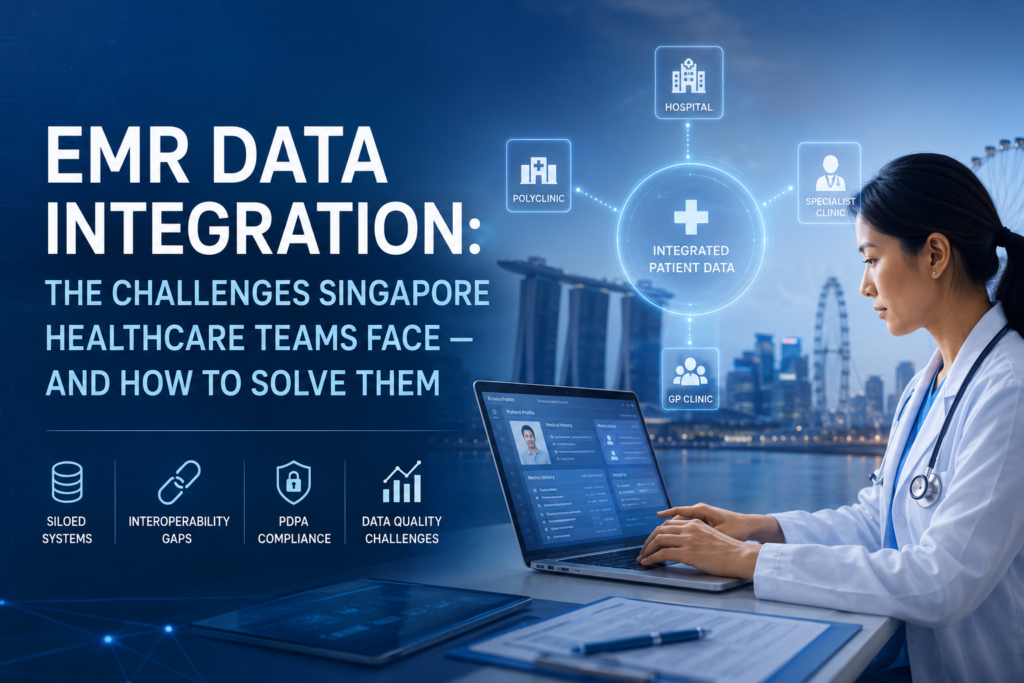
Picture this: a patient arrives at a specialist clinic in Singapore with a referral from their polyclinic. The specialist opens their EMR system and finds a summary note — but no lab results, no imaging history, no complete medication record. The clinical team spends the first fifteen minutes of the appointment trying to reconstruct a picture that already exists somewhere in the system. It is just not in their system.
This is not an isolated story. It plays out in clinics, hospitals, and specialist practices across Singapore every week. The data exists. The problem is that it lives in disconnected systems that were never designed to share it cleanly.
EMR data integration — connecting electronic medical record systems so that clinical, operational, and administrative data flows between them accurately and in real time — is one of the most consequential technology challenges in Singapore’s healthcare sector right now. The Ministry of Health’s ongoing digitisation push under Healthier SG has put the spotlight on interoperability, but the underlying data challenges are more complex than policy frameworks alone can solve.
This article covers the specific integration challenges Singapore healthcare teams face most often, what drives them, and the practical approaches that are working. It draws on work done by the team at Engine Analytics, a data analytics company in Singapore that works with healthcare and enterprise clients on data pipeline design, integration architecture, and connected reporting.
Most healthcare leaders understand, in principle, that their data is fragmented. What is less well understood is why integration remains so difficult even when the motivation to solve it is strong and the budget is available.
The first reason is system heterogeneity. Singapore’s healthcare landscape spans public hospitals under the two major clusters, polyclinics, private specialist practices, and GP clinics — and each segment tends to run different EMR platforms. Vendors like Allscripts, Cerner, and locally developed hospital information systems coexist alongside practice management software built for small clinics. These platforms store data in different formats, use different coding conventions, and have varying levels of API capability.
The second reason is that EMR systems were designed to capture clinical data, not to share it. Most legacy systems were built for documentation and billing — not for interoperability. Retrofitting data-sharing capability onto a system that was never designed for it requires significant middleware, careful mapping work, and ongoing maintenance that many teams underestimate from the outset.
The third reason is patient data sensitivity. Every integration decision in healthcare happens under the shadow of PDPA compliance and Ministry of Health data governance requirements. This is not just a compliance checkbox — it shapes which data can move, how it must be encrypted, where it can be stored, and who can access it. Integration approaches that work in other industries often need substantial redesign to work in healthcare.
Across engagements with healthcare clients, the same categories of integration problems appear repeatedly.
Siloed systems with no shared patient identifier is the most fundamental. When a polyclinic, a hospital, and a specialist practice each hold patient records under different internal IDs, joining those records requires either a shared national identifier — such as the NRIC — or a manual reconciliation process. The former requires careful governance. The latter does not scale.
Data quality inconsistencies compound the problem significantly. When two systems record the same information differently — one system stores diagnosis codes using ICD-10, another uses free-text descriptions, a third uses an older proprietary coding scheme — the data cannot be reliably compared or aggregated without a transformation layer. Inconsistent date formats, missing fields, duplicate records, and variant name spellings create noise that undermines any downstream analytics built on top of the source data.
Batch processing when real time is needed is a challenge that matters most in clinical settings. Many integration architectures move data on a scheduled basis — once every few hours, or overnight. For administrative reporting, this is usually acceptable. For clinical decision support, it is not. A medication alert that fires twelve hours after a prescription is written is not useful. Building the data infrastructure to support real-time data movement in a healthcare environment is substantially more complex than batch integration — as the piece on real-time analytics covers in detail.
Lack of clear data ownership is more common than most IT teams admit. When two departments share a patient record, it is often unclear which system is the system of record, who is responsible for resolving conflicts between the two, and what happens when a field is updated in one system but not the other. Without clear ownership logic, data drift accumulates quietly and creates errors that surface at the worst possible times — often during an audit or a clinical review.
Singapore’s healthcare data environment sits at the intersection of several regulatory frameworks — and any integration project needs to be designed with all of them in mind from the start.
The Personal Data Protection Act requires that patient data be collected for a specific purpose, held securely, not transferred unnecessarily, and disposed of when no longer needed. In the context of integration, this means every data movement decision has a compliance implication. Can the destination system store this data? Is this transfer covered by the original consent the patient provided? Is the data encrypted in transit and at rest?
Beyond PDPA, the Ministry of Health’s National Electronic Health Record system creates a set of expectations around what data can and cannot be shared across providers. Participation in NEHR comes with data contribution requirements and access controls that integration architects need to understand and design around. Teams that treat these requirements as an afterthought typically encounter delays and costly rework at the implementation stage.
For healthcare organisations moving toward cloud-based integration infrastructure — which most eventually do, given cost and scalability — there is an additional layer of consideration around where data is physically stored. Singapore-based cloud hosting is generally preferred for regulated health data, and any international data transfers require explicit justification under the PDPA’s cross-border transfer obligations.
These governance requirements do not make integration impossible. They make it slower and more deliberate than comparable projects in other industries. Healthcare teams that approach integration with governance built into the design — rather than bolted on at the end — consistently achieve better outcomes and avoid the expensive rework that comes from discovering a compliance gap after the pipeline is already live.
The consequences of poor EMR integration tend to be framed in patient safety terms — and those risks are real. But the operational and financial costs deserve equal attention, because they are often what finally drives healthcare organisations to invest in fixing the underlying problem.
Staff time spent on manual reconciliation is the most visible cost. When nursing staff, administrators, or clinicians spend significant parts of their day copying data between systems, looking up records in multiple platforms, or resolving discrepancies between conflicting entries, the labour cost is direct and measurable. It is also the kind of cost that compounds silently — most organisations have normalised the manual work to the point where they no longer count it.
Decision quality degrades when data is incomplete. A clinician making a treatment decision without a complete medication history, an operations team running capacity planning on data that is two days old, a finance team reconciling billing records against clinical records by hand — these are all decisions made on incomplete information that better integration would have prevented. The consequences range from avoidable clinical errors to budget forecasting that is structurally unreliable.
Reporting is where fragmented data creates serious downstream problems for leadership. When the data feeding operational dashboards comes from multiple systems that are not joined correctly, the numbers cannot be trusted. This erodes confidence in analytics across the organisation, causes leadership teams to rely on instinct over evidence, and makes it genuinely difficult to demonstrate operational improvement over time. Data that is not trusted does not get used — and that is a significant opportunity cost.
These costs are consistently underestimated during the scoping phase of integration projects. The visible cost is the integration build itself. The invisible cost is everything the organisation spends every month continuing to operate in a fragmented data environment.
A well-integrated EMR data environment has several characteristics that distinguish it from patchwork systems built one connection at a time.
It uses a standardised data exchange format. HL7 FHIR has emerged as the preferred standard for healthcare data interoperability globally, and Singapore’s health technology ecosystem is moving in this direction. Integration built around FHIR reduces the per-connection translation cost and makes it substantially easier to onboard new systems without rebuilding existing pipelines from scratch.
It separates integration from analytics. The systems that move data are not the same systems that analyse it. A well-designed architecture moves data from source systems into a clean, well-governed data layer, and analytics tools read from that layer rather than directly from operational systems. This separation reduces risk to live clinical systems and makes it much easier to build reliable reporting. The approach is covered in more detail in the article on what data engineering means for business operations.
It has clear data lineage. Every data point in the analytics layer should be traceable back to its source system. This matters for audits, for debugging data quality issues, and for building trust with clinical and operational teams who need to act on the numbers. When a clinician or administrator questions a figure in a dashboard, the answer to “where did this come from?” should be answerable in minutes, not days.
It monitors data quality continuously. Data quality in a live integration environment is not a one-time check — it is an ongoing signal. Automated monitoring that flags record counts, field completion rates, and anomalous values when they fall outside expected ranges catches problems early, before they compound into the kind of larger errors that erode trust in the entire analytics layer.
At Engine Analytics — a data analytics company in Singapore — we work with healthcare organisations that are trying to build a reliable data foundation across their EMR systems and operational platforms. The problems we encounter most often are the same ones described above: systems that do not share data cleanly, analytics that cannot be trusted, and teams spending significant manual effort on work that should be automated.
Our approach is to build a structured integration layer that sits between source systems and reporting tools. Through our data and AI services, we design and implement pipelines that extract data from EMR platforms, standardise it, apply data quality logic, and load it into a centralised analytical environment where it can be queried, reported on, and connected to operational workflows — without creating dependency on any single source system.
For healthcare teams that need ongoing support rather than a one-off build, our engagement model is structured to scale with your organisation — quarterly reviews, pipeline monitoring, and dashboard iteration included. You can also explore our project portfolio to see how this kind of integration architecture has been implemented in practice.
If your organisation is dealing with fragmented EMR data, unreliable reporting, or manual processes that should be automated, get in touch and we can walk through what a connected data environment would look like for your specific setup.
EMR data integration in Singapore is not primarily a technology problem. The tools to connect systems exist. The standards to guide integration architecture are maturing. The real challenge is the combination of system complexity, data governance requirements, and organisational readiness that sits behind every integration project.
Healthcare teams that approach this systematically — starting with clear data ownership, designing governance into the architecture from the beginning, and building the separation between integration and analytics — consistently produce better outcomes than teams that try to solve it with point-to-point connections and manual processes.
The goal is not a perfectly unified EMR. The goal is a data environment where clinical, operational, and administrative decisions can be made on accurate, timely, and complete information. That is achievable. It just requires more rigour than most organisations initially plan for.
EMR data integration refers to the process of connecting electronic medical record systems so that clinical, administrative, and operational data can flow between them reliably. In Singapore’s healthcare context, it matters because the system spans public hospitals, polyclinics, specialist practices, and GP clinics that often run different platforms with limited native interoperability. Without integration, patient data remains fragmented across systems, which creates gaps in clinical decision-making, generates significant manual reconciliation workload for staff, and makes it difficult to produce accurate operational or financial reporting at an organisational level.
PDPA introduces specific requirements around the collection, storage, transfer, and disposal of patient data that integration architects must account for at the design stage. Any data movement between systems needs to be covered by the original consent the patient provided, or that consent must be updated. Data transferred between systems must be encrypted in transit and at rest, and the destination system must meet the same security standards as the source. Organisations that treat PDPA compliance as a final review rather than an architectural constraint typically encounter delays, costly rework, and in some cases require significant redesign of completed integrations.
Our work in healthcare integration focuses on building a clean analytical layer between source EMR systems and reporting tools — rather than connecting systems directly to each other. This architectural decision reduces risk to live clinical systems, creates a single governed environment for all analytics, and makes it significantly easier to maintain the integration over time as source systems change. We also build continuous data quality monitoring into every pipeline we deliver, so data issues are flagged automatically rather than discovered when someone questions a number in a dashboard. Visit the Engine Analytics contact page to discuss your organisation’s specific setup.
