
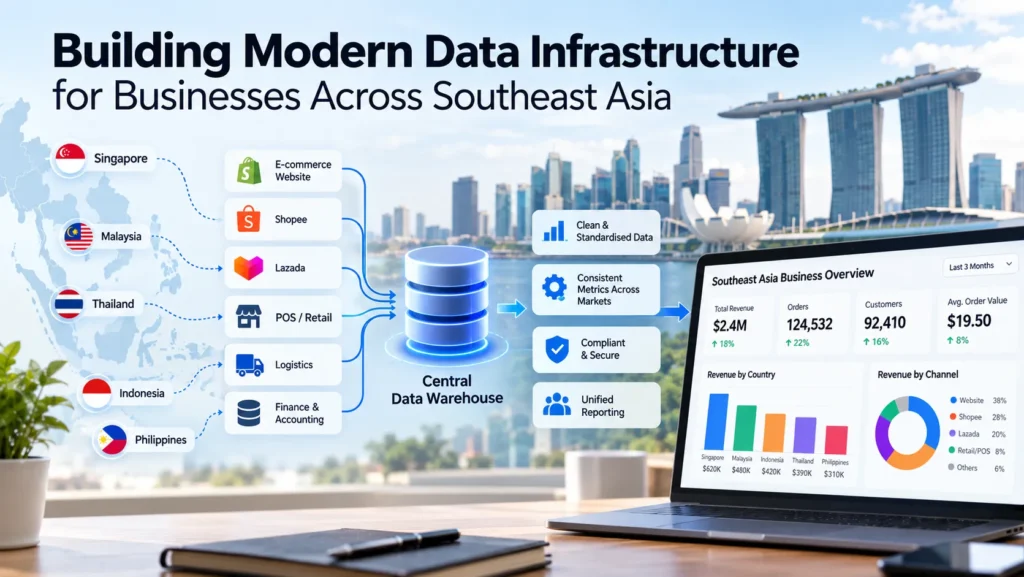
A Singapore-headquartered consumer brand sells in Singapore, Malaysia, Indonesia, Thailand, and the Philippines, through its own website and through Shopee and Lazada. Each country team reports in its own currency, using its own definition of net sales, from its own spreadsheet. At month end the regional finance lead consolidates them by hand, converting currencies at whatever rate each team used. The consolidated Q3 revenue figure is reissued twice. The second reissue changes the regional growth rate enough that the board asks whether any of the numbers can be relied on.
Nothing in this story is unusual for a business operating across Southeast Asia. The region’s markets differ in currency, language, payment habits, marketplace mix, and data protection law, and a data setup that grows country by country, tool by tool, ends up reflecting all of those differences without anyone having designed for them. This article covers what makes the region distinctive for data infrastructure and the design principles that let one setup serve many markets. It draws on the approach used by Engine Analytics, a data analytics company in Singapore that builds data infrastructure for regional businesses.
Southeast Asia is not one market. A regional business typically deals with several currencies, time zones spanning a couple of hours, and multiple languages in product names, customer messages, and addresses. Sales flow through a mix of own-site, marketplaces such as Shopee and Lazada, social commerce, and offline channels, each producing data in a different shape. Payment methods vary by country, from cards and bank transfers to e-wallets and cash on delivery, and each has different settlement timing and refund behaviour. Local systems — accounting packages, logistics providers, point-of-sale — differ from market to market and vary widely in data quality.
Each of these differences is manageable. The trouble comes when they are handled independently by each country team. Definitions drift, currency conversion is inconsistent, and the regional view can only be assembled by manual reconciliation. The aim of a regional data infrastructure is to absorb those differences in a shared structure so that the business can compare markets on equal terms.
The most important decision is to build a single core data model with the market as a dimension, rather than a separate setup per country. Orders, customers, products, and marketing spend have the same structure everywhere, with fields identifying the country, channel, and currency. Local variations — a marketplace that exists in only one country, a payment method with its own fields — are handled as configuration or extensions of the shared model, not as forks of it. This is what allows a new country to be onboarded in weeks by connecting its sources to an existing template, and what makes cross-market questions answerable without heroic spreadsheet work.
Currency should be handled in the data layer, not in reports. Store every transaction in its original currency, alongside a reporting currency amount calculated with a dated exchange rate table, so that any figure can be traced and restated if the rate policy changes. Time should be stored consistently, typically in UTC, and converted to local time only for display, which avoids the day-boundary errors that make daily sales disagree between systems. Language needs a product master with a stable identifier and translated names, so the same product is recognised across markets and marketplaces. These are unglamorous decisions, but they are the ones that determine whether regional figures reconcile or not. The wider principle — that trustworthy reporting depends on the layer underneath it — is covered in our article on data engineering for business leaders.
Each market in the region has its own data protection regime, and they do not line up neatly. Singapore’s Personal Data Protection Act, Malaysia’s Personal Data Protection Act, Indonesia’s personal data protection law, Thailand’s Personal Data Protection Act, and the Philippines’ Data Privacy Act all impose obligations on how personal data is collected, used, stored, and transferred, and Vietnam has its own evolving rules. The details differ, including conditions on transferring data across borders and the treatment of sensitive categories, and some sectors carry additional requirements. This is not legal advice, and any regional design should be reviewed with counsel who know each market.
From an architecture standpoint, a few decisions make compliance far easier. Choose the warehouse location deliberately — Google Cloud, for example, has regions in both Singapore and Jakarta — and document why. Separate personally identifiable information from analytical data early, so that most analysis runs on pseudonymised records. Apply access controls by role and by market. Log who accesses what. Decisions taken at design time cost little; retrofitting them after a regulator’s query or an incident is expensive.
Marketplace and local-system data is where regional projects most often stall. Shopee, Lazada, and TikTok Shop each expose data differently, through APIs, seller-centre exports, or partner tools, and coverage varies. Local ERPs and payment gateways add further variety. The practical approach is to standardise the pattern rather than the tool: every source lands raw in the warehouse, passes through a staging layer that maps it to the shared model, and is covered by the same tests and monitoring. Expect uneven quality at the edges and build validation for it — missing fields, delayed settlements, and duplicated orders are routine. A step-by-step pattern for a single source is shown in our guide to integrating Google Ads data into BigQuery, and the same discipline applies to every marketplace connection.
Most regional projects that struggle make the same handful of mistakes. They build country by country and try to merge the results later, which bakes in inconsistent definitions. They convert currency inside dashboards, so every report applies its own rate. They leave marketplace and local-system data until the end, when it turns out to be the messiest part. They have no regional owner for metric definitions, so local teams quietly diverge. They treat compliance as something to check after launch. And they over-invest in tools before agreeing what the numbers mean. Avoiding these is less about technology than about sequencing: agree the shared model and definitions first, then connect the markets to it.
Regional infrastructure is best built in stages. Start with the home market to prove the core model and the reporting structure. Then create an onboarding template — a checklist covering sources, currency, tax treatment, definitions, and compliance review — and use it for each new country. Assign an owner for metric definitions at regional level, so local teams can request changes but not quietly diverge. A common mistake is trying to launch every market at once; a staged rollout surfaces design flaws while they are still cheap to fix. A structured approach with an experienced partner, as described in our article on what a data engineering consultant does, shortens this considerably.
If your regional reporting depends on manual consolidation, each country defines its metrics differently, or you are planning to enter new markets on top of an unstructured setup, the path forward is a shared data foundation designed for the region. View our data and AI services, explore our engagement plans, see what we have built in our project portfolio, or get in touch and we can review your current setup and outline what a regional foundation requires.
Engine Analytics is a data analytics company in Singapore that builds the data foundations — multi-market warehouses, consistent definitions, and audience-specific reporting — that regional businesses need to see across markets on equal terms.
Singapore is a common hub because of its connectivity and its regional role, and Jakarta is available for teams with Indonesian requirements. The right choice depends on where your data originates, the transfer and residency rules that apply, and where your users and other systems sit. If personal data from several countries is involved, confirm the position with legal counsel before deciding.
Store each transaction in its original currency and also record an amount in a single reporting currency, calculated using a dated exchange rate table. This keeps the original figures intact, allows restatement if your rate policy changes, and ensures every team reports on the same basis. Do the conversion in the data layer rather than in individual dashboards.
Yes. We design the shared data model, connect your marketplaces and local systems, handle currency and time normalisation, build in access controls suited to your compliance needs, and deliver reporting by market and by audience. Get in touch via the Engine Analytics contact page to start with a review of your regional reporting.
— Engine Analytics | Singapore’s data and AI consultancy — building the regional data foundations that let businesses compare markets on equal terms and grow across Southeast Asia with confidence.
