
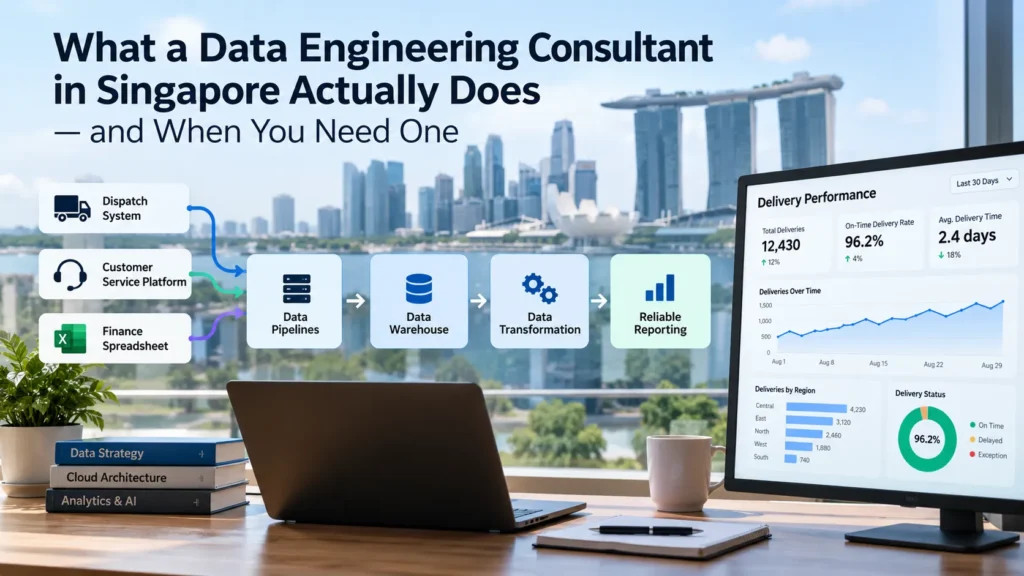
The operations director of a Singapore logistics company asks for a single view of delivery performance. She gets three answers from three tools: the dispatch system, the customer service platform, and a finance spreadsheet. She hires a freelance data person, who builds a set of dashboards in two months. They work. Six months later the freelancer moves on, and the company discovers that the dashboards depend on a set of manual exports, one hard-coded API key, and a spreadsheet only he understood. When a source system changes its export format, everything stops, and nobody in the company can say what needs fixing.
The problem was not the freelancer’s skill. It was that the company needed data engineering — a reliable foundation of pipelines, models, and monitoring — and bought dashboards. This article explains what a data engineering consultant in Singapore actually does, how the role differs from an analyst or a data scientist, the signs that you need one, the cases where you do not, and how to choose between a consultant, a full-time hire, and a fractional arrangement. It draws on the approach used by Engine Analytics, a data analytics company in Singapore that builds data infrastructure for growing businesses.
The three data roles are often confused. A data analyst answers business questions using data that already exists in usable form, producing reports, dashboards, and analysis. A data scientist builds predictive models, such as churn prediction or demand forecasting. A data engineer builds the infrastructure that makes both possible: the pipelines that move data from source systems into a central warehouse, the models that turn raw records into clean, consistent tables, and the monitoring that catches problems before they reach a report.
The relationship is one of dependency. Analysts and data scientists are only as good as the data they are given, and when that data is unreliable, they spend most of their time cleaning it. A business that hires analysts before it has a data foundation tends to find them doing engineering work badly, and leaving when the frustration builds. The order matters: foundation first, analysis on top.
A consultant’s work usually follows a sequence. It begins with an assessment of the current state: which data sources exist, how data moves between them today, where the manual steps and single points of failure are, and which reports the business actually relies on. From that, the consultant designs a target architecture — typically a cloud warehouse such as BigQuery, ingestion for each source, a transformation layer, and a reporting layer — sized for the business rather than for a hypothetical enterprise.
The build phase covers pipelines for each source, modelling of core business entities and metrics with agreed definitions, automated testing and monitoring, and access controls that fit the organisation’s data protection obligations. A good engagement also covers what surrounds the code: cost management on the cloud platform, documentation, and a structured handover so the client’s team can operate what has been built. A modern transformation layer built with a tool such as dbt, described in our article on how dbt is changing pipeline development, is a common part of this.
A typical engagement runs in four phases. The first one to two weeks are an assessment: mapping sources, reviewing existing reports, and agreeing which decisions the business most needs data for. The next phase sets the architecture and priorities, including which sources and reports to tackle first. The build follows in order of business value rather than in order of technical convenience — the handful of reports leadership actually uses come before the long tail of nice-to-have sources. The final phase is handover and stabilisation, where the client’s team takes over operation, supported by documentation and working sessions. Throughout, the business should see working output early, such as one reconciled metric in a live dashboard within the first few weeks, not a single reveal at the end.
Certain symptoms reliably point to a foundation problem. Different teams report different numbers for the same metric. Reports depend on manual exports and spreadsheets that one person maintains. Pipelines break when a source system changes and nobody knows until a stakeholder notices. Each new data source takes weeks to integrate because there is no standard pattern. Cloud costs are rising without a clear explanation. Or the business is about to start an AI or machine learning project and has no reliable dataset to feed it. Expanding into new markets is another trigger, because the cost of an unstructured setup multiplies with each additional country and currency.
The common thread is that the business has outgrown ad hoc reporting and now depends on data for decisions, but the underlying structure was never designed. A consultant can assess this quickly and tell you whether it is a small repair or a substantial rebuild — an assessment that is worth having before committing to a full-time hire or a large platform purchase.
Honest consulting includes saying when the answer is no. A business with one or two data sources, modest volumes, and reports that already agree may be well served by the built-in tools of those systems. If the actual problem is poor tracking on the website, or a lack of analytical skill in the team, a data engineering project will not fix it. And if nobody makes decisions from the data yet, the first need is usually a clear question, not infrastructure. A good consultant will point to these situations rather than sell a project the business does not need.
A full-time data engineer makes sense when there is continuous, substantial engineering work — many sources, ongoing model development, and a team relying on the platform daily. A consultant is a better fit for a defined outcome: designing and building the foundation, fixing a broken setup, or migrating to a new platform, after which the workload drops to maintenance. A retainer or fractional arrangement suits the middle ground, where the business needs regular engineering capacity but not a full salary. Many companies use a combination: a consultant to build the foundation and train the team, then a fractional or junior in-house hire to maintain it.
The main risk with consultants is dependency. It is managed by insisting on a few basics: the code lives in your repository, the cloud accounts belong to you, everything is documented, and the handover includes working sessions with your team rather than a folder of files. If a consultant resists any of these, that is a warning sign.
Five questions separate experienced engineering consultants from dashboard builders. Ask how they will document metric definitions, and who owns them. Ask how they test and monitor pipelines, and how you will find out when something fails. Ask what will belong to you at the end — code, cloud accounts, documentation. Ask how they handle data protection, including where data will be stored and who can access it, which matters under Singapore’s Personal Data Protection Act and, for regional businesses, the rules in each market. And ask for examples of similar work, including one where the plan changed and how they handled it. The broader principles a business leader should know are covered in data engineering for business leaders.
If your reports disagree, your pipelines depend on manual steps, or you are planning to scale into new markets or AI projects on top of an unstructured setup, the path forward starts with an honest assessment of the foundation. View our data and AI services, explore our engagement plans, see what we have built in our project portfolio, or get in touch and we can review your current data setup and tell you whether you need an engineering project at all.
Engine Analytics is a data analytics company in Singapore that builds the data foundations — pipelines, warehouse models, and audience-specific reporting — that businesses need to make decisions from data they trust.
A data engineer builds and maintains the infrastructure that collects, cleans, and organises data — pipelines, warehouse models, and monitoring. A data analyst uses that prepared data to answer business questions through reports, dashboards, and analysis. Analysts depend on the quality of the engineer’s work, which is why the data foundation should come before the analysis layer.
An initial assessment of your current setup usually takes one to three weeks. Building a foundation — warehouse, pipelines for core sources, modelled metrics, monitoring, and first dashboards — typically takes six to twelve weeks depending on the number of sources and the condition of the underlying data. Ongoing support after that is usually lighter and can be arranged as a retainer.
Yes. We assess your current setup, design the architecture, build the pipelines and models, add testing and monitoring, and hand over with documentation and training so your team can run it. Get in touch via the Engine Analytics contact page to start with a review of your data foundation.
— Engine Analytics | Singapore’s data and AI consultancy — building the data foundations that let businesses stop patching reports and start relying on them.
