
A Singapore SaaS business reaches Series B. Headcount has doubled in eighteen months. The sales team wants pipeline dashboards. The product team wants retention cohorts. The finance team wants revenue waterfall reporting. Customer success wants churn risk signals. The single analyst on the team is producing all of it manually — downloading exports, running SQL, pasting numbers into slides — and spending so much time on data assembly that there is almost no time left for actual analysis.
The instinctive response is to hire more analysts. The better response, in most cases, is to build better infrastructure. The difference between a company that needs six analysts to support a two-hundred-person business and one that needs two is almost never the complexity of the questions being asked. It is the quality of the data engineering underneath the analytics layer.
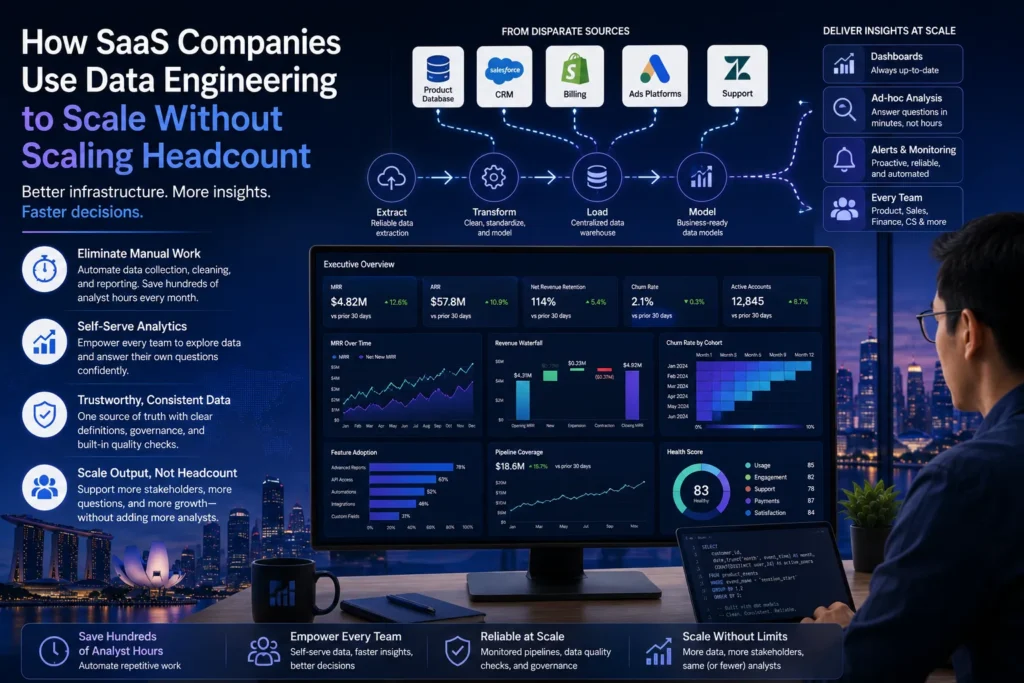
Data engineering — building the pipelines, data models, and self-serve infrastructure that analytical work depends on — is what allows SaaS companies to grow their analytical output significantly faster than their analytical headcount. This article covers exactly how that works: the specific manual work that data engineering replaces, the data models that make self-serve analytics possible, and what the operational picture looks like for a SaaS business that has built this foundation properly. It draws on the approach used by Engine Analytics, a data and AI consultancy in Singapore that builds data engineering infrastructure for SaaS businesses at growth stage and beyond.
Without data engineering infrastructure, analytical capacity scales with people. Every new stakeholder who wants data requires someone to produce it. Every new question requires someone to write a query, pull an export, join a spreadsheet, and format a slide. The work compounds as the business grows: more teams, more questions, more data sources, more reports to maintain. The analyst team that was one step behind at fifty employees is three steps behind at two hundred.
The deeper problem is that most of the work in this model is not analysis — it is assembly. An analyst spending four hours a week maintaining a revenue report that pulls from three systems and needs to be reconciled manually is not doing analysis for four hours. They are doing data plumbing for four hours, and the plumbing produces a result that is out of date the moment it is finished. The analysis that would actually inform a decision — the cohort comparison, the churn driver investigation, the pricing sensitivity study — never gets done because the week is already full of maintenance work.
This is the headcount trap: the business grows, the analytical demand grows, and the response is to hire people who then spend most of their time on manual data assembly rather than on the work the business actually needed them for. The trap compounds until either the analytical backlog becomes visibly damaging or someone makes the decision to invest in the infrastructure that makes the whole model work differently.
Data engineering, at its core, is the discipline of making data move reliably and arrive in a useful form without manual intervention. For a SaaS business, this means building pipelines that pull data from every relevant source — the product database, the CRM, the billing system, the ad platforms, the support tool — and land it in a central analytical layer on a defined schedule, cleaned, standardised, and ready to query. The piece on what data engineering means for business leaders covers this foundation in detail. For a SaaS business specifically, the payoff is that every stakeholder who previously needed an analyst to produce their data can instead query it directly — or open a dashboard that is already built and already current.
The transformation layer is the part of data engineering that most directly replaces manual work. Transformation logic — the SQL or dbt models that join tables, apply business definitions, calculate derived metrics, and produce the clean, labelled datasets that dashboards and analysts read from — runs automatically on every pipeline cycle. The revenue waterfall that took an analyst four hours to assemble in Excel runs in sixty seconds and is available every morning before anyone arrives at their desk.
Scheduling and orchestration ensure that pipelines run in the right order, at the right time, with monitoring that alerts when something fails. A SaaS business with ten data sources feeding a central analytical layer needs those sources to arrive in the right sequence — billing data before revenue models, CRM data before customer metrics — and needs to know immediately if any source is late or missing. Without orchestration, pipeline failures are discovered when a dashboard shows stale data and someone asks why. With orchestration, they are caught and addressed before anyone is affected.
The most immediate replacement is the weekly or monthly report assembly process. In most SaaS businesses without data engineering infrastructure, recurring reports are assembled manually: someone exports data from multiple sources, joins it in a spreadsheet, applies the relevant calculations, and populates a template. Data engineering replaces this entirely — the same logic runs automatically on a schedule and the report is always current without anyone touching it. The analyst who was spending a day a week on report assembly gets that day back for actual analysis.
Ad-hoc data requests — “can you pull the retention rate for enterprise customers who onboarded in Q1?” — are the second major category. Without a clean, well-modelled analytical layer, every ad-hoc request requires an analyst to locate the relevant tables, understand how they join, write the query, validate the result, and format it for the stakeholder. With a well-built data model where customer tiers, onboarding dates, and retention events are already defined and queryable in a consistent schema, the same request takes minutes rather than hours and can often be answered directly by the stakeholder without involving an analyst at all.
Data pipeline maintenance — fixing broken exports, updating queries when a source system changes its schema, reconciling discrepancies between two systems that report the same metric differently — is the third major category. This work is invisible when it is running well and highly disruptive when it fails. Proper data engineering infrastructure makes this maintenance systematic rather than reactive: schema changes are detected automatically, pipeline failures trigger alerts, and the analytical layer continues to produce accurate data even when upstream sources change. This is the same reliability principle that makes real-time analytics viable at scale — the infrastructure is robust enough to operate without constant human intervention.
Self-serve analytics — the ability for product managers, sales leads, and finance directors to answer their own data questions without routing requests through an analyst — depends entirely on the quality of the data models underneath the self-serve interface. A data model that accurately represents how the business works, uses consistent definitions for every metric, and covers the questions that each team actually asks allows non-technical users to explore data confidently. A poorly built data model produces results that look right but are not, which is worse than no self-serve capability at all because it generates bad decisions that nobody questions.
For a SaaS business, the core data models typically cover customers, subscriptions, product usage, and revenue. A customer model that tracks every account, its tier, its lifecycle stage, and its key attributes. A subscription model that records every plan, every change, and every renewal, with clear definitions for MRR, ARR, expansion, and churn that apply consistently across all downstream reporting. A product usage model that captures feature-level engagement events and translates them into the behavioural signals — active user rates, feature adoption, session frequency — that product and customer success teams need. Revenue models that reconcile billing records with subscription events and produce the waterfall views finance requires.
When these models are built correctly and documented clearly, an analyst can onboard a new stakeholder to self-serve reporting in an hour rather than maintaining a bespoke report for them indefinitely. The analytical team’s time shifts from data production to data interpretation — answering the harder questions that emerge once teams have reliable access to the standard metrics.
A SaaS business that has built proper data engineering infrastructure looks different in a few specific ways. Reporting meetings start with everyone looking at the same numbers from the same source, rather than each team arriving with their own version of the data and the first twenty minutes being spent reconciling discrepancies. New stakeholder requests for data are met with a dashboard link or a query against a clean data model, not with a one-to-two week wait for an analyst to build something from scratch. When a pipeline fails, the monitoring system catches it before anyone’s dashboard goes stale.
The analyst team’s work changes in character. Less time is spent on data assembly and more is spent on the questions that data engineering cannot answer automatically — the investigative work, the causal analysis, the modelling that requires human judgement about what to look for and what it means. This is the work that produces the insights that actually inform product and commercial strategy. It is also the work that is most valuable and most engaging for the analysts doing it, which has a measurable effect on retention.
If your analytics team is spending more time on data assembly than on analysis, or if your stakeholders are waiting too long for answers to questions that should be straightforward, the investment that changes that picture is almost always infrastructure, not headcount. View our data and AI services, explore our engagement plans, see our project portfolio, or get in touch and we can assess where your current analytical infrastructure stands and what it would take to build something your team can genuinely scale with.
Engine Analytics is a data analytics company in Singapore that builds the data engineering foundations that allow SaaS businesses to grow their analytical output significantly faster than their analytical headcount.
The upfront investment in data engineering infrastructure typically pays back within two to four quarters in analyst time recovered. A well-built pipeline and data model layer eliminates a significant proportion of the manual assembly work that consumes analyst capacity, which either frees existing analysts for higher-value work or reduces the number of additional analysts the business needs to hire as it grows. The ongoing maintenance cost is also substantially lower than the cost of the equivalent human time.
For a business with three to eight primary data sources and moderate data complexity, a foundational data engineering layer — pipelines, core data models, monitoring, and initial self-serve reporting — typically takes six to ten weeks to build properly. The timeline extends if there are significant data quality problems to resolve in source systems, or if the number of sources is large and the join logic is complex.
Yes. We design and build the full data engineering layer — source pipelines, transformation models, orchestration, monitoring, and the reporting infrastructure on top. We work with SaaS businesses at growth stage and beyond, and we offer ongoing support through our engagement plans for teams that want the infrastructure maintained and evolved as the business grows. Get in touch via the Engine Analytics contact page to discuss your current setup.
— Engine Analytics | Singapore’s data and AI consultancy — building the data engineering foundations that let SaaS businesses scale their analytical output without scaling their analytical headcount.
