
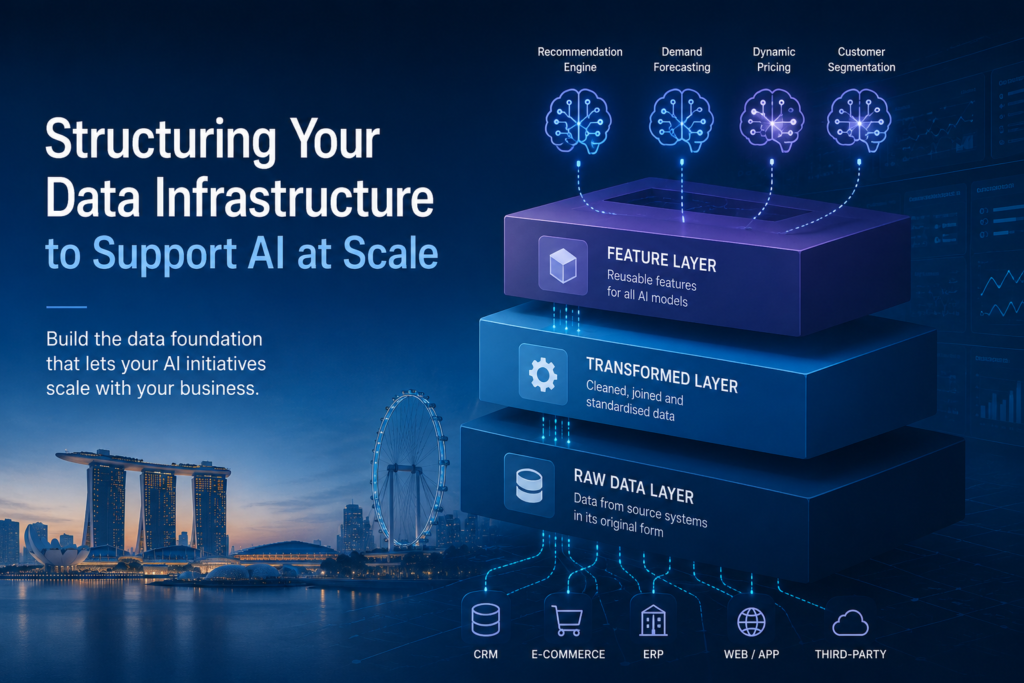
A Singapore retail business builds its first AI use case — a product recommendation engine — on a data pipeline the team assembled in a few weeks. It works well. Results are good. Leadership sees the output and approves three more AI initiatives: a demand forecasting model, a dynamic pricing system, and a customer segmentation engine. Six months later, the engineering team is spending most of their time maintaining the original pipeline rather than building the new ones. Every new AI use case requires bespoke data plumbing that does not connect cleanly to what already exists.
This is the scale problem organisations hit when AI moves from experiment to programme. The first use case is built on whatever data infrastructure is available. That infrastructure was designed to serve one model, at one cadence, for one team. When the second and third use cases arrive — each with different data requirements, different freshness needs, and different feature engineering logic — the ad-hoc infrastructure collapses under the cumulative weight of what is being asked of it.
Structuring data infrastructure to support AI at scale is a different problem from building infrastructure to support a single AI project. It requires deliberate architectural decisions about how data is ingested, stored, transformed, and served to models — decisions that are expensive to undo once the infrastructure is embedded in production systems. This article covers those decisions and why they matter. It draws on the approach used by Engine Analytics, a data and AI consultancy in Singapore that designs infrastructure for businesses moving from individual AI experiments to sustained AI programmes.
When organisations talk about scaling AI, the conversation tends to focus on compute — more GPU capacity, larger models, faster inference. These are real requirements for specific use cases, but they are rarely what actually prevents AI from scaling. What prevents AI from scaling is data infrastructure that was not designed to serve multiple models simultaneously, at different cadences, with different feature requirements, without each pipeline interfering with the others.
The difference becomes concrete quickly. A single AI model needs a data pipeline that delivers clean, labelled training data on some schedule. Multiple AI models need data infrastructure that can serve different subsets of data to different models, on different schedules, with different transformation logic applied — and they need a feature layer where computed inputs can be stored and reused across use cases rather than rebuilt from scratch for each new project. Without this infrastructure, every new AI initiative becomes a bespoke project that re-solves problems the previous project already solved. This is the pattern that makes AI programmes feel disproportionately expensive relative to their output.
The businesses that scale AI efficiently are not the ones with the most sophisticated models. They are the ones that invested in the data infrastructure layer early enough that each new AI use case could be built on top of existing foundations rather than alongside them.
The architectural decisions that matter most for scalable AI infrastructure are made early and are costly to change later. The first is the separation between raw data, transformed data, and features. Raw data should be stored exactly as it arrives from source systems, with full history preserved. Transformation — cleaning, joining, aggregating, standardising — should happen in a separate, version-controlled layer. Features — the computed inputs models actually train on — should be stored in a dedicated layer that models can read from consistently at both training time and inference time. When these three layers are conflated, each new model creates its own version of each layer, and the infrastructure becomes an overlapping tangle of pipelines with no single source of truth.
The second critical decision is the data movement pattern. Batch processing — moving data on a schedule — works for AI use cases where the model does not need very recent data. Real-time or near-real-time data movement is necessary when the model is making decisions that depend on current state: fraud detection, live personalisation, or dynamic pricing. Getting this choice wrong means either rebuilding the pipeline when a real-time use case arrives, or forcing it onto batch infrastructure that cannot support it. As the piece on real-time analytics covers, the infrastructure requirements for real-time and batch data movement are substantially different and the choice needs to be made based on the actual latency needs of the AI systems being built, not on what the first use case happened to require.
The third is the governance model for feature definitions. When multiple AI models reference the same underlying concept — “customer lifetime value”, “days since last purchase”, “product affinity score” — but each computes it differently, the outputs of those models cannot be meaningfully compared or combined. A feature governance framework that standardises definitions and enforces consistency across all AI pipelines is not glamorous infrastructure, but it is what prevents a situation where three models in production are each defining the same business concept differently and producing outputs that no one can reconcile.
Data quality management becomes significantly more complex when multiple AI pipelines are reading from shared infrastructure. A quality problem in one field of one upstream table can degrade multiple models simultaneously. If monitoring is not in place at the infrastructure level, that degradation may not be detected until it surfaces in model outputs — by which point the business has been acting on unreliable AI predictions for an unknown period of time.
Scalable AI infrastructure needs data quality monitoring built into the pipeline layer, not added as an afterthought. This means automated checks on record volume, field completion rates, statistical distributions, and referential integrity — running on every data movement cycle and alerting when something falls outside expected ranges. The alternative is discovering quality problems by working backwards from unusual model behaviour, a process that can take days and that leaves degraded AI systems in production while the investigation runs.
Schema governance is equally important. When source systems change — a field gets renamed, a new category is added, a CRM migration changes the customer ID format — those changes can break multiple downstream AI pipelines simultaneously if there is no governance layer that catches and manages schema changes before they propagate. At single-model scale, a schema break is a contained problem. At multi-model scale, it is an incident affecting the entire AI programme.
Direct database connections from AI pipelines to operational systems work for the first use case. As the number of models grows, the query load on operational systems increases, and the risk that AI training jobs affect production system performance becomes real. The right pattern is a dedicated analytical data layer — a data warehouse or data lake — that mirrors operational data and serves as the read layer for all AI pipelines, completely separated from production systems. Every model reads from the analytical layer. Nothing reads directly from operational databases.
Per-model feature engineering — where each model computes its own version of each feature from raw data — creates duplication and inconsistency that compounds as the model inventory grows. A feature layer in the data warehouse, or a dedicated feature store, allows features to be computed once and reused across models. This reduces pipeline complexity, ensures consistency across use cases, and makes it possible to update a feature definition in one place rather than across multiple model codebases simultaneously.
Manual pipeline orchestration — where data movement jobs are triggered manually or through ad-hoc scheduling — does not survive the complexity of multiple concurrent AI pipelines with interdependencies. A proper orchestration layer is necessary once the infrastructure grows beyond a handful of pipelines. This is part of what foundational data engineering covers: the operational infrastructure that makes data pipelines reliable, observable, and maintainable at the scale an AI programme requires.
Whether you are building your first AI use case and want to start with infrastructure that will not need to be rebuilt, or managing a growing AI programme on infrastructure that is beginning to strain, the architectural decisions above are the ones that matter. View our data and AI services, explore our engagement plans, review our project portfolio, or get in touch and we can assess your current infrastructure and map out what it needs to look like to support AI reliably as your programme grows.
Engine Analytics is a data analytics company in Singapore that designs and builds the data infrastructure that makes AI programmes scalable — from raw data layers and pipeline orchestration through to feature governance and quality monitoring.
A dedicated analytical data layer, completely separate from your operational systems, that all AI pipelines read from. Without it, every new model adds query pressure to production systems and rebuilds data that no one else can reuse. That single architectural decision eliminates the majority of problems that make AI programmes expensive to scale.
Not necessarily from day one. A well-governed set of tables in a data warehouse can serve the same function early on. What matters is that features are computed in one place, stored consistently, and reusable across models. A dedicated feature store becomes worth the investment when managing feature consistency across separate model codebases starts becoming a real maintenance burden.
We design the data infrastructure AI programmes need to grow beyond a single use case — data layers, pipeline architecture, feature engineering frameworks, quality monitoring, and governance processes. We also work with teams that have built AI on ad-hoc infrastructure and need to restructure it for scale without breaking what is currently in production. Get in touch via the Engine Analytics contact page to discuss where your infrastructure currently stands.
