
Healthcare systems across Southeast Asia are moving through a period of rapid digital transformation. Hospitals, clinics, insurance providers, and medical research institutions are investing heavily in technology to improve patient outcomes, reduce operational inefficiencies, and create more connected healthcare ecosystems. Despite these investments, many Healthcare Organisations in Southeast Asia continue to struggle with fragmented systems, poor interoperability, inconsistent reporting, and outdated infrastructure strategies.
The challenge is not always a lack of technology. In many cases, the real issue is the absence of a scalable data foundation. Modern healthcare depends on accurate, accessible, and secure information. Without the right infrastructure, even advanced software tools fail to deliver meaningful value.
Today, healthcare leaders are expected to manage growing patient volumes, support remote care, maintain regulatory compliance, and improve decision making simultaneously. That requires a strong approach to healthcare data management Southeast Asia organizations can trust for long term growth.
Many institutions are now turning toward platforms that improve analytics, integration, and governance. Businesses looking to modernize their systems can explore the tailored solutions available through Engine Analytics and its specialized data services.
Healthcare providers generate enormous amounts of data every day. Electronic health records, laboratory systems, pharmacy databases, imaging platforms, financial software, wearable devices, and telemedicine applications all contribute to increasingly complex environments.
Unfortunately, many Healthcare Organisations in Southeast Asia still operate with disconnected systems that cannot communicate effectively. Departments often store information independently, creating duplicate records and inconsistent reporting structures.
This fragmentation creates operational bottlenecks such as:
In fast growing healthcare markets, these inefficiencies become even more damaging over time.
One of the most common mistakes Healthcare Organisations in Southeast Asia make is viewing digital transformation in healthcare as a one time software upgrade instead of an ongoing operational strategy.
Many institutions purchase enterprise systems without fully preparing their infrastructure, governance models, or internal workflows. As a result, expensive platforms are implemented without proper integration planning or staff alignment.
True digital maturity requires:
Without these elements, hospitals often end up with isolated systems that create more complexity rather than reducing it.
According to the World Health Organization, healthcare digitization initiatives succeed when organizations align technology with governance, workforce capability, and long term operational goals.
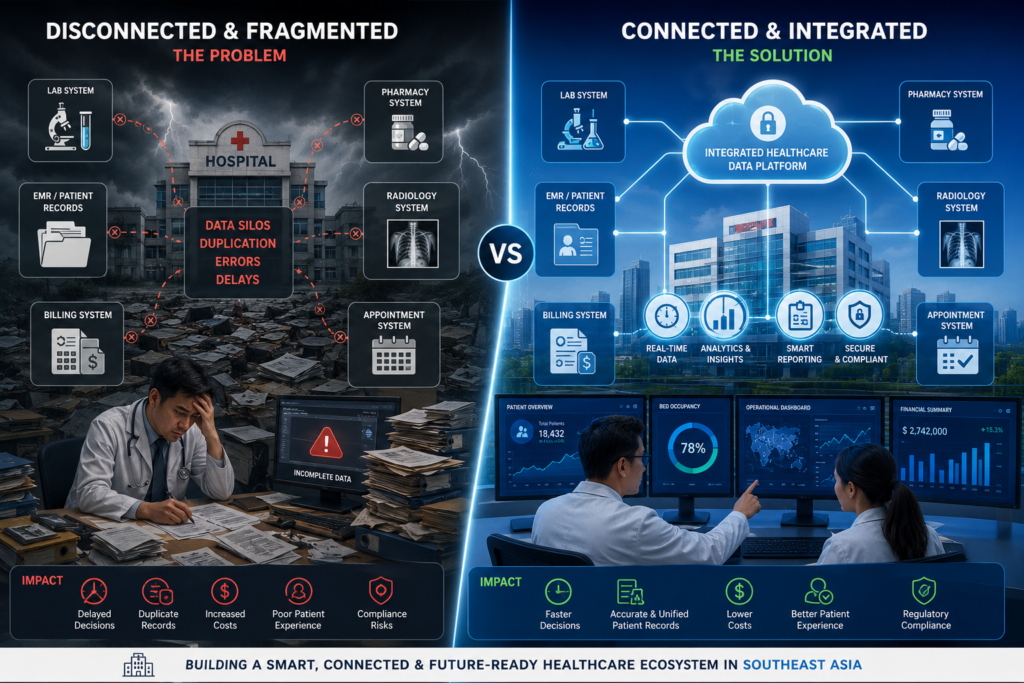
Effective hospital data integration remains one of the biggest operational challenges in the region. Many hospitals continue using separate systems for admissions, diagnostics, billing, and patient records.
When systems cannot exchange information efficiently, clinicians may not have complete visibility into patient history. Administrative teams also struggle to create reliable performance reports.
For example, a patient may receive treatment from multiple departments during a single hospital visit. If data remains siloed, medical staff might miss important clinical details, causing delays or unnecessary duplication of tests.
Healthcare Organisations in Southeast Asia often underestimate how critical interoperability is to both operational efficiency and patient safety.
Modern integration frameworks allow healthcare institutions to:
Organizations that invest early in integration frameworks position themselves for faster innovation and improved scalability.
Many hospitals across the region still rely on outdated on premise systems built years ago. While these systems may continue functioning, they often lack the flexibility required for modern healthcare operations.
Legacy infrastructure creates several limitations:
As patient volumes grow, older systems struggle to process larger datasets and increased workloads efficiently.
Healthcare leaders require near real time reporting to support operational and clinical decisions. Older infrastructure often introduces delays that reduce responsiveness.
Maintaining aging systems consumes valuable IT resources while increasing operational risk.
Outdated environments are often more vulnerable to cyber threats and compliance failures.
Healthcare Organisations in Southeast Asia must recognize that healthcare IT infrastructure Asia markets require today is fundamentally different from what hospitals needed ten years ago.
Cloud enabled architectures, secure APIs, centralized data lakes, and modern governance models are now essential components of resilient healthcare infrastructure.
Technology alone cannot solve healthcare data challenges. Governance plays a critical role in ensuring information remains secure, accurate, and accessible.
Many Healthcare Organisations in Southeast Asia lack clearly defined governance policies. Teams may use different standards for data entry, reporting, or access permissions.
Without governance, organizations experience:
Strong governance frameworks establish clear ownership, validation standards, and security protocols.
Healthcare providers must also comply with evolving regional privacy regulations while protecting highly sensitive patient information.
The Asian Development Bank has repeatedly emphasized the importance of digital governance frameworks in supporting sustainable healthcare modernization across Asia.
Many healthcare institutions believe success means collecting large amounts of information. However, data becomes valuable only when it can be accessed, interpreted, and applied effectively.
Healthcare analytics solutions help organizations transform raw information into actionable insights. Unfortunately, many institutions still struggle to operationalize their data effectively.
Common usability problems include:
Healthcare Organisations in Southeast Asia frequently invest in data storage without developing strong analytics capabilities.
Modern analytics systems can help healthcare leaders:
The ability to make faster and more informed decisions increasingly separates high performing healthcare organizations from struggling institutions.
Even the best infrastructure strategy can fail without workforce alignment. Many digital initiatives focus heavily on technology while overlooking employee readiness and adoption.
Healthcare staff often experience frustration when systems are introduced without sufficient training or workflow planning.
Healthcare Organisations in Southeast Asia sometimes underestimate the cultural and operational changes required during digital transformation projects.
Successful implementation requires:
When employees understand how systems improve daily operations, adoption rates improve significantly.
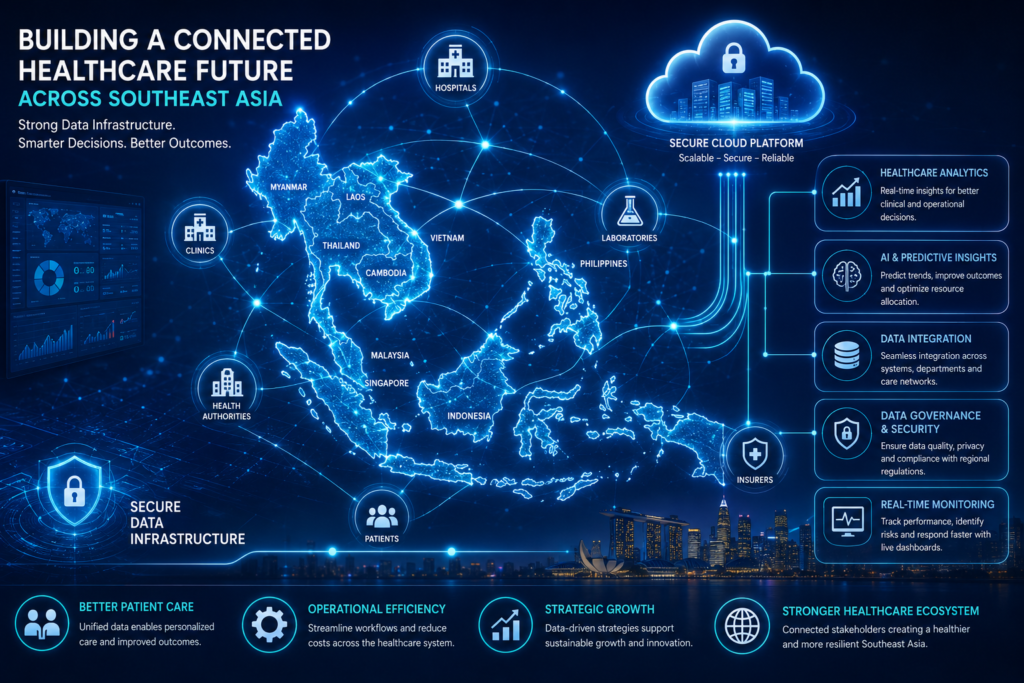
Scalability is another area where many Healthcare Organisations in Southeast Asia fall behind. Infrastructure decisions are often made based on short term operational needs instead of long term expansion.
Healthcare systems must prepare for:
Scalable infrastructure allows organizations to adapt quickly without rebuilding entire systems repeatedly.
This is especially important in Southeast Asia, where healthcare demand continues rising rapidly due to urbanization, aging populations, and increasing healthcare access.
Organizations seeking scalable modernization strategies can connect directly with the team through the contact page for tailored guidance.
Healthcare remains one of the most targeted sectors for cyberattacks globally. Patient records contain highly sensitive information, making healthcare databases attractive targets for attackers.
Many Healthcare Organisations in Southeast Asia still operate with fragmented security frameworks that expose critical vulnerabilities.
Common cybersecurity weaknesses include:
Cybersecurity should never be treated as a secondary IT function. It must become part of overall infrastructure strategy from the beginning.
Modern healthcare environments require:
Organizations that fail to modernize security practices risk operational disruption, reputational damage, and regulatory consequences.
The future of healthcare depends heavily on connected, intelligent, and scalable infrastructure. Institutions that modernize strategically will gain major advantages in efficiency, patient experience, and long term sustainability.
Healthcare Organisations in Southeast Asia are now reaching a critical turning point. Incremental upgrades are no longer enough. Healthcare leaders must rethink how data flows across their organizations and how technology supports long term operational goals.
Forward thinking institutions are prioritizing:
As competition increases, healthcare providers that fail to modernize may struggle to meet rising patient expectations and regulatory requirements.
Another issue that continues affecting Healthcare Organisations in Southeast Asia is the disconnect between executive leadership, operational teams, and technology departments. Infrastructure projects are frequently delegated entirely to IT divisions without meaningful involvement from clinical leaders or administrators. This creates systems that may function technically but fail to support real operational workflows inside hospitals and healthcare networks.
Leadership alignment is essential because infrastructure decisions influence every department across an organization. Finance teams need accurate reporting. Doctors require immediate access to patient information. Operations managers depend on performance visibility. Compliance officers need secure governance controls. When leadership groups operate independently, infrastructure priorities become fragmented and long term planning weakens significantly.
Healthcare Organisations in Southeast Asia also face challenges related to budget allocation. Many organizations invest heavily in visible front end technologies while underfunding backend architecture and integration capabilities. Although patient facing applications appear modern, the underlying systems often remain disconnected and inefficient.
To avoid these problems, organizations should establish enterprise wide data strategies that include measurable operational goals and accountability structures. Successful healthcare modernization usually includes:
Healthcare Organisations in Southeast Asia that create alignment between technology, operations, and leadership are far more likely to achieve sustainable transformation outcomes. Instead of treating infrastructure as a background IT responsibility, successful institutions recognize data systems as a strategic foundation supporting patient care, operational efficiency, regulatory compliance, and future innovation across the entire healthcare ecosystem.
Organizations that delay modernization often discover that small operational inefficiencies eventually become major financial and clinical burdens. Building resilient infrastructure today helps healthcare providers adapt faster to policy changes, emerging technologies, patient expectations, and regional expansion opportunities tomorrow. Strong infrastructure also improves collaboration between healthcare partners, insurers, laboratories, and government agencies, creating a connected healthcare environment capable of delivering safer, faster, and efficient services consistently at scale.
Modern healthcare operations depend on reliable, connected, and scalable data infrastructure. Yet many Healthcare Organisations in Southeast Asia continue struggling with fragmented systems, outdated technologies, and weak governance practices that limit operational performance.
The organizations that succeed over the next decade will be those that prioritize integration, analytics, scalability, and security as part of a unified digital strategy.
Businesses seeking practical support for healthcare modernization can explore the solutions available through Engine Analytics to build smarter, more resilient healthcare systems for the future.
Hospital data integration allows different healthcare systems and departments to communicate with each other seamlessly. When patient records, billing systems, laboratory reports, and diagnostic tools are connected, healthcare providers can access accurate information quickly. This reduces duplicate entries, minimizes medical errors, improves operational efficiency, and helps doctors make faster and better treatment decisions for patients.
Digital transformation in healthcare helps organizations modernize outdated processes through automation, cloud systems, analytics platforms, and connected technologies. It improves reporting accuracy, streamlines administrative tasks, enhances patient experiences, and supports better decision making with real time insights. Healthcare providers can also improve efficiency, reduce operational costs, and deliver faster services through digitally connected systems.
Healthcare providers often face infrastructure challenges such as disconnected systems, outdated legacy software, poor interoperability between departments, and limited scalability. Many organizations also struggle with cybersecurity risks, inconsistent data governance, and difficulties in managing growing volumes of healthcare data. Without modern infrastructure, hospitals may experience delays, reporting errors, and reduced operational visibility.
