Table of Contents
Data used to be a back-office activity—rows, tables, dashboards, and endless spreadsheet juggling. But today, data is the heartbeat of competitive strategy. Every customer click, supply chain update, and sales touchpoint creates a trail of valuable information. The challenge? Most organizations still struggle to turn raw data into something meaningful.
Traditional analytics is slow, technical, and heavily dependent on analysts. Business users wait weeks for dashboards. Leaders often rely on outdated insights. Opportunities slip through the cracks simply because data moves slower than the business itself.
That’s exactly why Augmented Analytics is gaining momentum. It automates the toughest and most time-consuming parts of analytics, delivers quick answers, and gives decision-makers tools they can actually use—no coding required. By blending artificial intelligence, machine learning, and natural language processing, Augmented Analytics makes insights accessible to everyone.
This article walks you through what Augmented Analytics is, how it works, what benefits it delivers, the industries adopting it, and how your organization can begin using it today. Along the way, you’ll see how businesses worldwide are transforming data into strategic action much faster than ever before
What Is Augmented Analytics?
Augmented Analytics is a modern analytics approach that uses AI and machine learning to automate data preparation, accelerate insight discovery, and simplify reporting. It empowers users to interact with data using conversational queries and visual explanations—no deep technical background required.
Instead of manually exploring data for patterns or building predictive models from scratch, Augmented Analytics tools surface:
Key drivers
Anomalies
Correlations
Customer behavior patterns
Operational inefficiencies
Predictive forecasts
Companies like Gartner describe Augmented Analytics as “an analytics paradigm where AI is used to enhance human intelligence throughout the analytics workflow.”
It represents the natural evolution of BI—from dashboards and SQL queries to automated, intelligent, and accessible analytics for everyone.

Why Augmented Analytics Is Rising So Quickly
1. Business Teams Need Insights Faster
In traditional analytics setups, business teams depend heavily on analysts and data engineers. A simple question like “Why did revenue dip last month?” might take days—or weeks—to answer.
Augmented Analytics eliminates that bottleneck by enabling self-service exploration. Users simply ask questions in plain English and the system delivers answers instantly.
2. Data Volumes Are Exploding
According to a study from Harvard Business Review, the average organization doubles its usable data every year. Manual analysis simply can’t keep up at this pace. Augmented Analytics automates the heavy lifting, helping teams find insights buried in massive datasets that humans may overlook.
3. Low-Code Analytics Tools Are Becoming the Norm
The shortage of skilled data professionals is real. Augmented Analytics tools bridge the gap by offering intuitive, low-code workflows that empower business users without overwhelming technical teams.
4. Organizations Want More AI-Driven Business Insights
As competition increases, predictive insights—not just historical reporting—are becoming essential. Augmented Analytics allows teams to make decisions proactively, not reactively.
5. Leaders Want Better Data-Driven Decision-Making
Executives need clarity quickly. Augmented Analytics turns data into a strategic advantage, allowing leaders to spot risks, opportunities, and trends before the competition does.
How Augmented Analytics Works Behind the Scenes
To understand its power, let’s break down the internal mechanisms driving Augmented Analytics.
Automated Data Preparation
Data cleaning can take up to 70% of an analyst’s time. Augmented systems automate:
Missing value handling
Outlier detection
Column matching
Data type correction
Transformation suggestions
This dramatically accelerates analytics workflows.
Machine Learning Insights Built In
What used to require data science expertise is now embedded directly into analytics tools. Automated ML models can:
Predict trends
Detect anomalies
Identify key drivers
Segment customers
Score performance
This enables smarter decisions in real time.
Natural Language Query (NLQ)
Users can ask things like:
“Which products had the highest growth this year?”
“Show me customer churn patterns.”
“What is projected revenue for Q4?”
The tool translates the question into a query and visualizes the answer instantly.
Automated Data Storytelling
Numbers alone don’t tell a story—but Augmented Analytics does. Automated narratives explain insights in clear, simple language, helping teams understand the “why” behind the data.
Proactive Insight Recommendations
The system scans datasets continuously and surfaces:
Opportunities
Threats
Anomalies
Demand shifts
Customer behavior changes
This allows your business to take action before problems escalate.
For businesses ready to modernize their analytics systems, the Engine Analytics Services team provides end-to-end implementation support.
How Augmented Analytics Works (Behind the Scenes)
1. Automated Data Integration
Augmented Analytics platforms connect with all your data sources—CRMs, ERPs, marketing tools, websites, apps, cloud databases—bringing everything into one ecosystem.
2. Automated Data Preparation
Data preparation is traditionally the most time-consuming step in analytics.
Augmented Analytics automates:
Cleaning
Normalizing
Merging
Structuring
Deduplicating
Handling missing values
This saves teams countless hours and ensures better data quality.
3. Automated Data Analysis
Machine learning algorithms scan your datasets to detect:
Patterns
Hidden relationships
Statistical anomalies
Trends
Outliers
Seasonality
What would require dozens of reports or dashboard drill-downs is uncovered automatically.

4. Natural Language Querying
Stakeholders can ask questions in plain language:
“What product category grew the fastest last month?”
“Why did our churn increase?”
“Which campaigns performed best in Q4?”
The system responds with visual explanations and machine learning insights.
5. Predictive & Prescriptive Recommendations
Instead of simply reporting what has happened, Augmented Analytics predicts:
What will happen
Why it will happen
What actions you should take
This reflects the modern analytics philosophy highlighted by Harvard Business Review—AI should augment human intelligence, not replace it:
Where Augmented Analytics Makes the Biggest Impact
Augmented Analytics unlocks benefits across the entire organization:
Marketing
Attribution insights
Customer segmentation
Content and campaign optimization
Churn prediction
Real-time performance insights
Sales
Improved lead scoring
Deal-closing predictions
Territory performance insight
Demand forecasting
Finance
Risk detection
Fraud detection
Predictive budgeting
Automated monthly reporting
Operations
Demand planning
Supply chain optimization
Bottleneck identification
Workforce efficiency analytics
Executives
Faster decision-making
Clear real-time business health
Predictive scenario modeling
Every team benefits because insights become immediate, accurate, and accessible—leading to better data-driven decision-making across the organization.
Augmented Analytics vs. Traditional Analytics
Here’s a quick comparison:
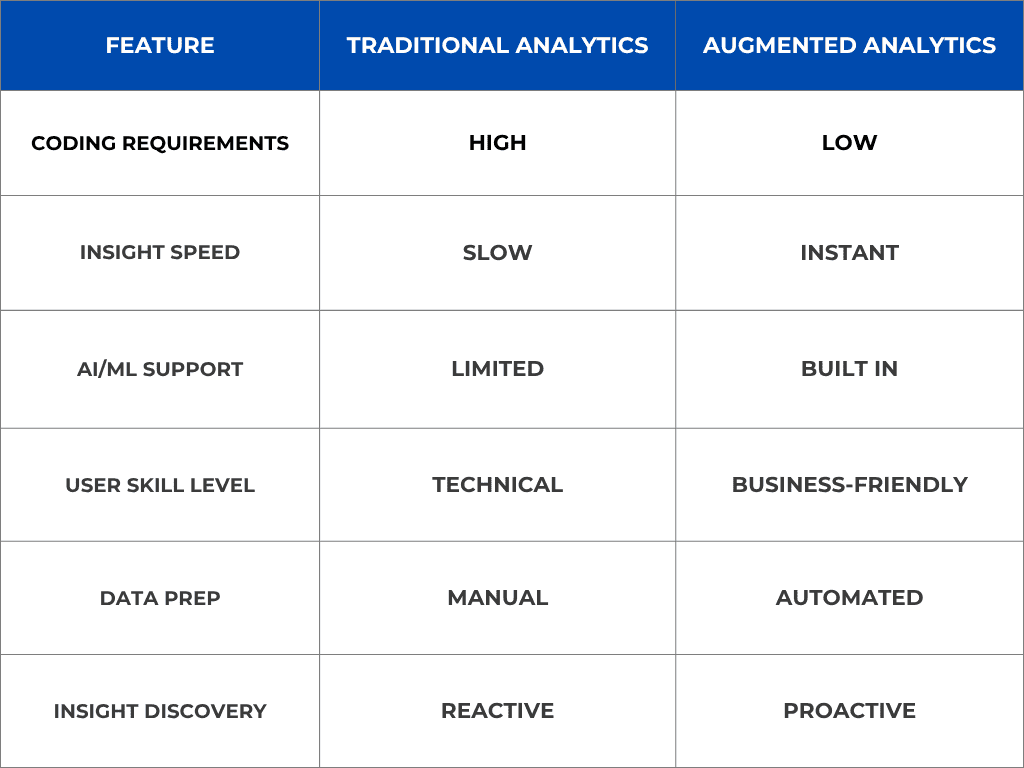
The difference is clear: Augmented Analytics delivers faster, smarter, and more scalable insights with minimal effort.
Real-World Impact: Where Augmented Analytics Creates Value
Industries everywhere are experiencing the benefits of Augmented Analytics.
Retail
Predict buyer trends
Optimize pricing
Personalize marketing offers
Finance
Improve fraud detection
Forecast investment risks
Track real-time portfolio performance
Healthcare
Analyze patient history
Optimize resource allocation
Improve diagnostic accuracy
Manufacturing
Predict downtime
Optimize supply chains
Reduce waste and inefficiency
Marketing & Sales
Identify high-value leads
Improve campaign ROI
Predict customer churn
Augmented Analytics transforms raw data into operational efficiency, customer satisfaction, and long-term profitability.
Key Business Benefits of Augmented Analytics
1. Massive Time Savings
Automating data preparation and analysis eliminates tedious manual tasks.
2. Better Accuracy and Trust
Machine learning minimizes human error and uncovers deeper insights.
3. Broader Analytics Access
Non-technical users gain the ability to drive discussions and decisions.
4. Increased Operational Efficiency
Teams spend less time on reporting and more time acting on insights.
5. Faster Response to Market Changes
Real-time intelligence enables immediate strategic adjustments.
6. Higher ROI on Data Investments
When insights are accessible and actionable, all data tools become more valuable.
Why Augmented Analytics Is the Future of Business Intelligence
Businesses are increasingly shifting from descriptive reporting (“What happened?”) to predictive and prescriptive intelligence (“What will happen and what should we do?”).
Augmented Analytics supports this evolution by:
Delivering automated intelligence
Reducing reliance on technical specialists
Encouraging organization-wide analytics adoption
Providing deeper insights faster
Supporting decision-makers across every department
For companies looking to modernize their analytics infrastructure, Augmented Analytics is not just helpful—it’s essential.
If your business wants to explore AI-powered analytics solutions tailored to your needs, you can explore the full services.
How Engine Analytics Helps You Implement Augmented Analytics
Adopting Augmented Analytics shouldn’t be complicated—and that’s exactly where Engine Analytics makes the difference. We help organizations move from scattered data and slow reporting to a streamlined, intelligent, AI-powered analytics environment that supports every level of decision-making.
Here’s how we support your journey:
✓ Unified Data Foundation
We connect your platforms, databases, applications, and tools to create a single, reliable source of truth—so your insights are always accurate and accessible.
✓ Automated, Real-Time Reporting
Manual reporting cycles become a thing of the past. We automate dashboards, alerts, and analytics workflows so teams receive insights exactly when they need them.
✓ Machine Learning Built for Your Business
Our experts design and deploy practical ML models that answer real business questions—forecasting trends, identifying risks, improving customer understanding, and more.
✓ Empowering Teams With Low-Code Analytics Tools
We implement intuitive, user-friendly analytics solutions that allow non-technical teams to explore data independently, ask questions in natural language, and act fast.
✓ Smarter Forecasting and Operational Planning
From demand planning to financial projections, we help organizations adopt AI-driven decision-making that improves accuracy and reduces uncertainty.
✓ End-to-End Analytics Support
Whether you’re modernizing your BI stack, scaling your data infrastructure, or adopting predictive intelligence, our team provides the strategy and execution needed to get results—quickly.
At Engine Analytics, our mission is simple:
Turn your data into meaningful intelligence that moves your business forward.
If you’d like to discuss a tailored analytics solution, connect with us.
Conclusion: Augmented Analytics Is Redefining What’s Possible
Augmented Analytics is no longer a future concept—it’s a practical advantage for businesses that want to move faster, operate smarter, and make decisions with confidence. By blending automation, AI, and intuitive analytics tools, it empowers every team to uncover insights that once required deep technical expertise.
In an environment where markets shift quickly and data grows endlessly, organizations that embrace Augmented Analytics gain a measurable edge. They identify opportunities earlier, respond to challenges sooner, and make choices grounded in clarity rather than guesswork.
If your business is ready to turn data into meaningful intelligence, elevate decision-making, and create a more agile, insight-driven culture, the next step is simple—connect with the team at Engine Analytics.
Here’s Some Interesting FAQs for You
1. What makes Augmented Analytics different from traditional analytics?
Traditional analytics depends heavily on manual data preparation, coding skills, and time-consuming dashboard exploration. Analysts must clean data, write queries, build models, and search for insights manually, which slows decision-making. Augmented Analytics, on the other hand, automates these steps using AI and machine learning. It handles data preparation, runs automated discovery, surfaces hidden patterns, and even generates predictive insights—allowing teams to access deeper intelligence with far less effort and far greater speed.
2. Do business users need technical skills to use Augmented Analytics?
No. One of the biggest advantages of Augmented Analytics is its accessibility for non-technical users. With features like natural language search, automated data analysis, and low-code analytics tools, business users can ask questions in plain English, explore visual insights, and uncover trends without needing to write code or understand advanced data science. This democratizes analytics across the organization and empowers more people to make informed, data-driven decisions.
3. Does Augmented Analytics replace data analysts?
Not at all. Augmented Analytics is designed to enhance the work of analysts—not replace them. By automating repetitive tasks like data cleaning, dashboard updates, and basic reporting, analysts can shift their focus toward higher-value work such as strategic modeling, deeper investigation, scenario planning, and advising leadership. In practice, Augmented Analytics acts like an intelligent assistant, freeing analysts from routine tasks so they can deliver more impactful insights.