Operational Analytics vs Strategic Analytics: What Should You Build First?

Table of Contents


In today’s data-rich business environment, leaders are under constant pressure to make faster, smarter, and more confident decisions. Dashboards are everywhere, reports are automated, and analytics tools are more powerful than ever. Yet one question continues to challenge executives, product owners, and data leaders alike: Operational Analytics vs Strategic Analytics — what should you build first?

This decision is not merely technical. It shapes how your organization responds to daily challenges, plans for long-term growth, and ultimately competes in the market. Choosing the wrong starting point can lead to stalled initiatives, low adoption, and analytics fatigue. Choosing the right one creates momentum, trust, and measurable business value.

This article explores the difference between operational and strategic analytics, when each is most valuable, and how to decide the right sequence for your business. By the end, you’ll have a clear framework to guide your Analytics Implementation Strategy and accelerate Data-Driven Decision Making with confidence.

Understanding Operational Analytics

Operational Analytics focuses on the here and now. It is designed to help teams monitor, manage, and optimize day-to-day business activities. Instead of asking, “Where should the company go next year?” operational analytics asks, “What is happening right now, and what should we do about it?”

What Operational Analytics Really Does

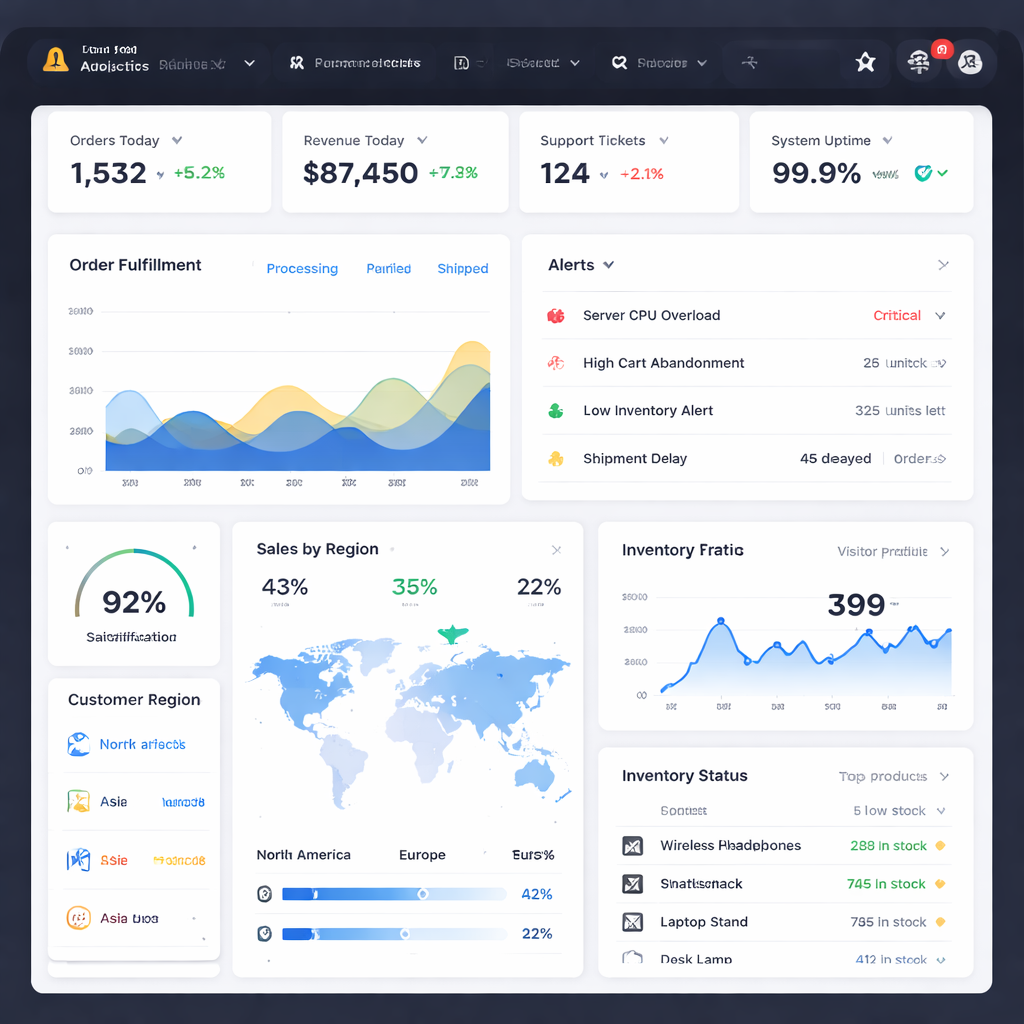
Operational analytics turns raw data into immediate insights that support frontline decision-making. It is deeply embedded into business workflows and often powers alerts, dashboards, and automated actions.

Common characteristics include:

  • Near real-time or real-time data processing

  • High data freshness and frequency

  • Focus on efficiency, productivity, and issue resolution

  • Used by operations, support, sales, logistics, and IT teams

This form of analytics often fuels Real-Time Business Intelligence, ensuring teams can act before small issues become costly problems.

Practical Examples of Operational Analytics

Operational analytics is already present in many successful organizations, even if it isn’t always labeled as such.

Examples include:

  • Monitoring system uptime and triggering alerts when performance drops

  • Tracking order fulfillment rates to prevent shipping delays

  • Managing call center queues to reduce customer wait times

  • Detecting anomalies in transactions to prevent fraud

In each case, analytics supports immediate action. There is little room for delay, and insights must be accurate, timely, and easy to interpret.

Understanding Strategic Analytics

Strategic Analytics operates at a different altitude. Instead of focusing on daily execution, it supports long-term planning, goal setting, and competitive positioning. It answers questions about direction, investment, and growth.

The Role of Strategic Analytics in Business

Strategic analytics combines historical data, trends, and predictive models to guide leadership decisions. It is less about speed and more about depth, context, and foresight.

Key characteristics include:

  • Aggregated and historical datasets

  • Advanced modeling and forecasting

  • Scenario analysis and trend identification

  • Used primarily by executives and senior leaders

This approach empowers organizations to make informed choices about markets, products, customers, and resources.

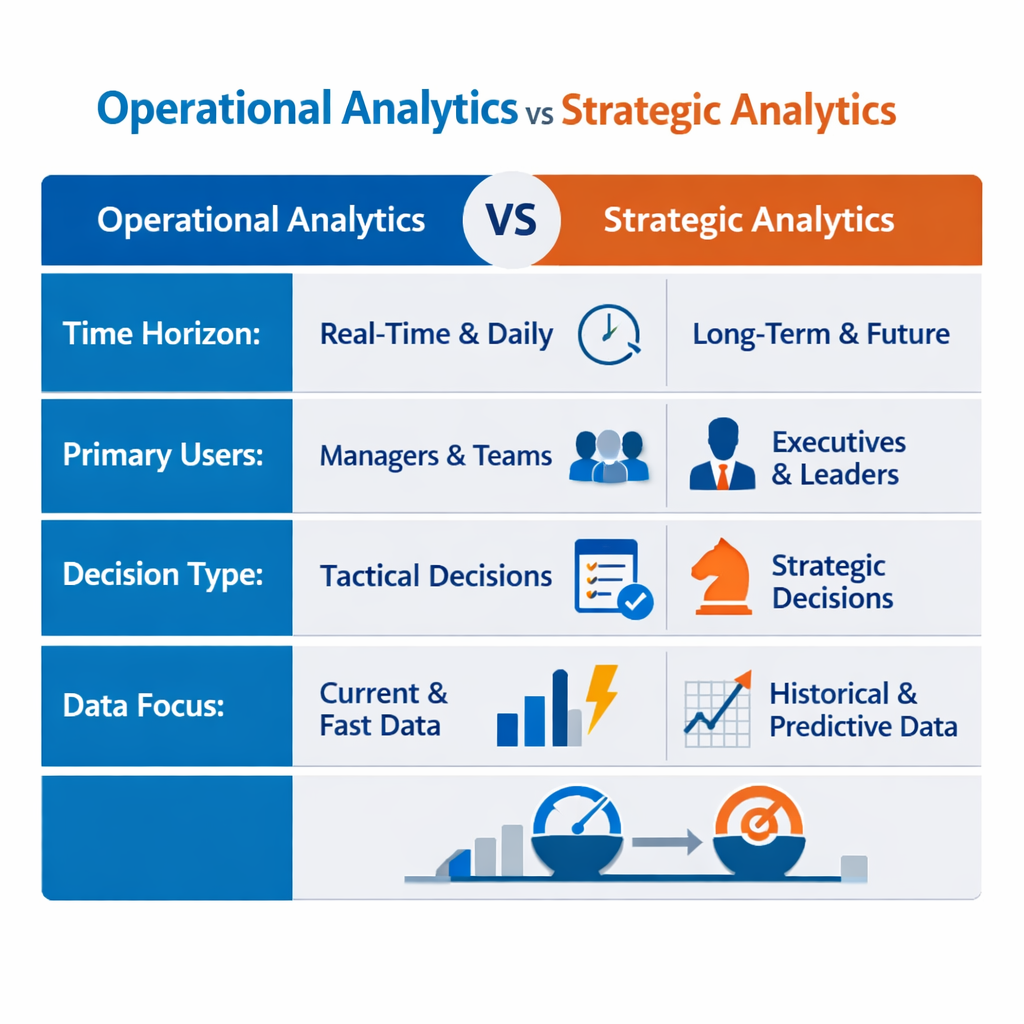
Operational Analytics vs Strategic Analytics

Strategic Analytics in Action

Strategic analytics often influences decisions that shape the future of the business.

Typical use cases include:

  • Forecasting revenue growth across regions

  • Identifying high-value customer segments

  • Evaluating pricing strategies and profitability

  • Assessing long-term supply chain risks

While these insights may not drive instant action, they significantly impact sustainability and competitive advantage.

Operational Analytics vs Strategic Analytics: Core Differences

To make the right choice, it helps to clearly understand how these two analytics approaches differ. The comparison between Operational Analytics vs Strategic Analytics is best viewed across time, users, and decision scope.

Key Dimensions of Difference

  • Time Horizon
    Operational analytics focuses on minutes, hours, or days. Strategic analytics looks at months, quarters, and years.

  • Primary Users
    Operational insights serve frontline teams and managers. Strategic insights support executives and planners.

  • Decision Type
    Operational analytics enables tactical decisions. Strategic analytics informs directional decisions.

  • Data Complexity
    Operational analytics prioritizes speed and accuracy. Strategic analytics emphasizes depth and modeling.

Understanding these distinctions clarifies why one is not inherently better than the other. They serve different purposes and, together, create a complete analytics ecosystem.

Why Many Organizations Start with Operational Analytics

For many businesses, operational analytics delivers faster and more visible wins. When teams see immediate improvements, analytics adoption increases organically.

Faster Time to Value

Operational analytics often relies on existing data sources and simpler models. This allows organizations to deliver dashboards and alerts quickly, demonstrating immediate ROI.

Benefits include:

  • Reduced downtime and inefficiencies

  • Improved response times

  • Better customer experiences

  • Increased trust in data systems

These early wins help justify further investment and align stakeholders around analytics initiatives.

Strong Foundation for Data Culture

By embedding analytics into daily workflows, organizations normalize data usage. Teams begin to rely on evidence rather than intuition, strengthening Data-Driven Decision Making at every level.

If your goal is to operationalize insights quickly, exploring analytics services like those outlined on the Engine Analytics services page can accelerate this journey.

When Strategic Analytics Should Come First

While operational analytics is often the starting point, it is not always the right first move. Some organizations benefit more from strategic analytics early on.

Situations Favoring Strategic Analytics

Strategic analytics may be the better initial focus when:

  • The business is undergoing major transformation

  • Leadership lacks clarity on long-term goals

  • Data sources are fragmented and need alignment

  • Investment decisions require strong justification

In such cases, building dashboards without a clear strategy can lead to misaligned metrics and wasted effort.

Aligning Analytics with Business Vision

Strategic analytics helps define what success looks like. Once leadership agrees on objectives and KPIs, operational analytics can then be designed to support those goals effectively.

Industry research from organizations like Gartner consistently emphasizes aligning analytics initiatives with business strategy to ensure sustainable value.

Operational Analytics vs Strategic Analytics


A Balanced Analytics Implementation Strategy

The debate around Operational Analytics vs Strategic Analytics is not about choosing one forever. It is about choosing the right starting point and sequencing initiatives intelligently.

The Phased Approach That Works

A successful Analytics Implementation Strategy often follows a phased model:

  1. Clarify business objectives

  2. Define strategic metrics and outcomes

  3. Implement operational analytics to support execution

  4. Continuously refine insights and models

This approach ensures analytics efforts remain aligned with evolving business needs.

Avoiding Common Pitfalls

Organizations often struggle when they:

  • Build dashboards without clear ownership

  • Over-engineer models before adoption

  • Ignore data quality and governance

  • Treat analytics as a one-time project

A balanced approach reduces these risks and creates long-term momentum.

The Role of Real-Time Business Intelligence

Real-time insights are becoming increasingly critical, especially in digital-first industries. Real-Time Business Intelligence bridges the gap between operational and strategic analytics.

Why Real-Time Matters

Real-time intelligence enables organizations to:

  • Respond instantly to market changes

  • Detect risks before they escalate

  • Personalize customer interactions

  • Optimize processes dynamically

When combined with strategic context, real-time analytics becomes a powerful competitive tool rather than just a monitoring system.

Choosing What to Build First: A Practical Decision Framework

To decide between Operational Analytics vs Strategic Analytics, ask the following questions:

  • Do teams need immediate visibility into daily performance?

  • Are leadership decisions currently based on incomplete data?

  • Is the organization aligned on goals and metrics?

  • What level of data maturity already exists?

Your answers will reveal whether operational efficiency or strategic clarity should come first.

If you need expert guidance in making this decision, connecting with the team via the Engine Analytics contact page can help you map the right path forward.

Learning from Industry Leaders

Many data-driven organizations blend both approaches seamlessly. Insights from firms such as McKinsey & Company highlight that companies excelling in analytics are significantly more likely to outperform their peers financially.

The lesson is clear: analytics success is not about tools alone, but about thoughtful sequencing and execution.

Conclusion: Building Analytics That Actually Work

The question of Operational Analytics vs Strategic Analytics is ultimately about priorities, timing, and business context. Operational analytics delivers quick wins and operational clarity. Strategic analytics provides direction, alignment, and long-term advantage.

Rather than viewing them as competing choices, successful organizations treat them as complementary layers of the same analytics vision. Start where your business needs the most clarity, then build forward with intention.

If you’re ready to design analytics that drive real outcomes, explore how Engine Analytics can help you turn data into decisions that matter.

Here’s Some Interesting FAQs for You

Operational analytics focuses on real-time and short-term decision-making, while strategic analytics supports long-term planning and business direction using historical and predictive data.

Yes. In fact, the most successful organizations integrate both. Strategic analytics defines goals, while operational analytics ensures those goals are executed efficiently.

If your organization has reliable data sources, clear objectives, and leadership support, you are ready to begin or expand analytics initiatives with confidence.