Measuring ROI of Analytics Beyond Vanity Metrics Questions

Table of Contents

Introduction: Why Measuring Analytics ROI Is Harder Than It Looks

Organizations invest heavily in analytics platforms, dashboards, data teams, and tools, yet many leaders still struggle to explain what value those investments actually deliver. Reports look impressive, metrics increase, and dashboards multiply, but executives are left asking a fundamental question: what is the real return? Measuring ROI of Analytics is not about counting dashboards or tracking logins. It is about understanding how analytics changes decisions, behaviors, and outcomes across the business.

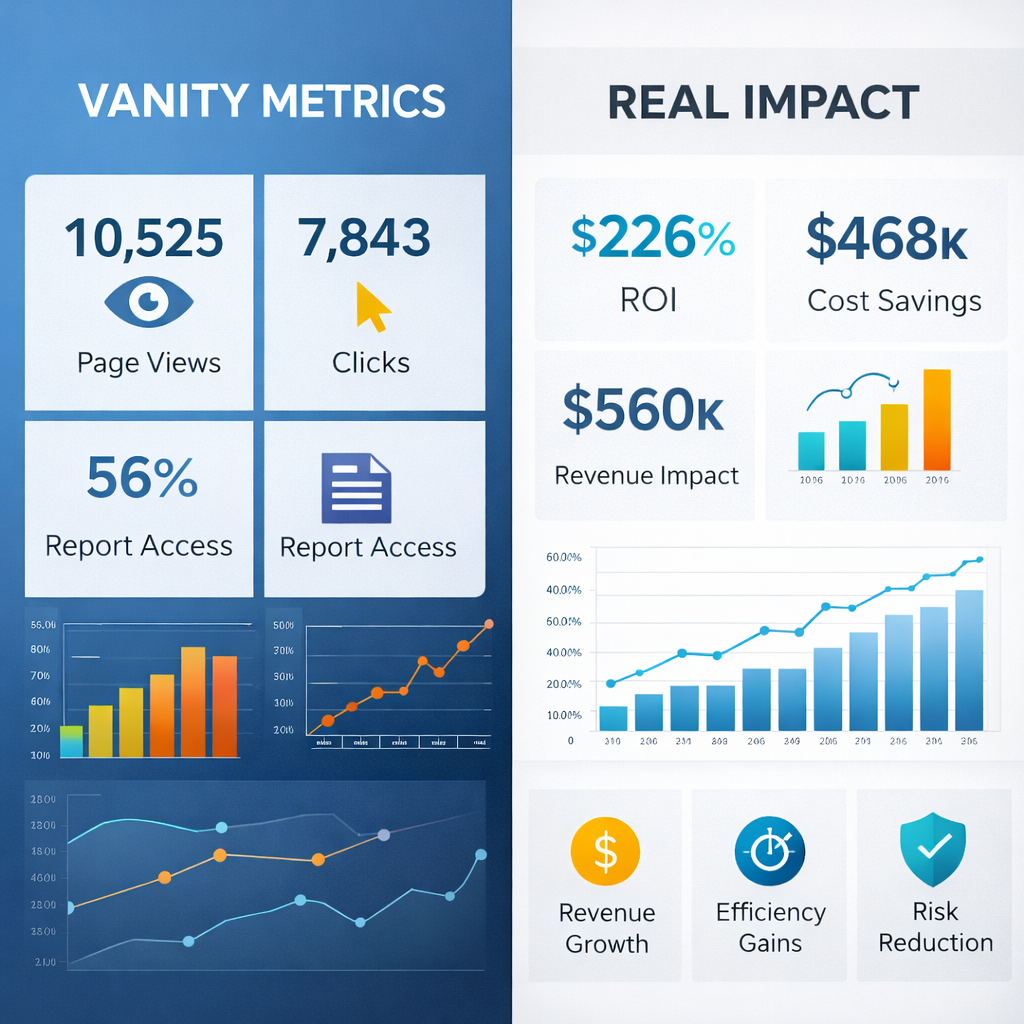
Vanity metrics create the illusion of progress without proving impact. Page views, report downloads, and data volume may look positive, but they rarely show how analytics improves revenue, efficiency, or risk management. Leaders need a better way to connect analytics initiatives to tangible business results.

This article explores how to move beyond surface-level metrics and build a practical, outcome-focused approach to analytics ROI. You will learn how to align analytics with strategy, define meaningful measurement frameworks, and demonstrate long-term value that stakeholders actually care about.

Why Vanity Metrics Fail to Show True Analytics Value

Vanity metrics are easy to track and easy to present, which is why they are so common. Unfortunately, they rarely answer the questions executives ask. Measuring ROI of Analytics requires moving past indicators that show activity instead of impact.

Examples of vanity metrics include:

  • Number of dashboards created

  • Frequency of report access

  • Volume of data processed

  • Tool adoption rates

These metrics describe usage, not value. They fail to explain whether analytics influenced decisions or improved outcomes. A report viewed but not acted upon delivers no return.

True analytics value is revealed only when insights change behavior, reduce costs, increase revenue, or improve customer experience.

Reframing Analytics ROI Around Business Outcomes

The most effective way to measure analytics ROI is to start with business outcomes instead of tools. Analytics exists to support strategy, not the other way around. Measuring ROI of Analytics begins by asking which outcomes matter most.

Key outcome categories include:

  • Revenue growth and profitability

  • Operational efficiency

  • Risk reduction and compliance

  • Customer satisfaction and retention

  • Speed and quality of decision-making

When analytics initiatives are directly tied to these outcomes, ROI becomes easier to define, track, and communicate.

Defining Analytics ROI Metrics That Matter

Effective Analytics ROI metrics focus on cause and effect. They connect insights to actions and actions to results. This requires leaders to define success before analysis begins.

Strong ROI metrics share three characteristics:

  • They align with strategic goals

  • They reflect measurable change

  • They support decision-making

For example, instead of tracking dashboard usage, track how analytics reduced customer churn or improved forecast accuracy. These metrics demonstrate value in terms leaders understand.

Measuring ROI of Analytics


Connecting Analytics to Data-Driven Decision Making

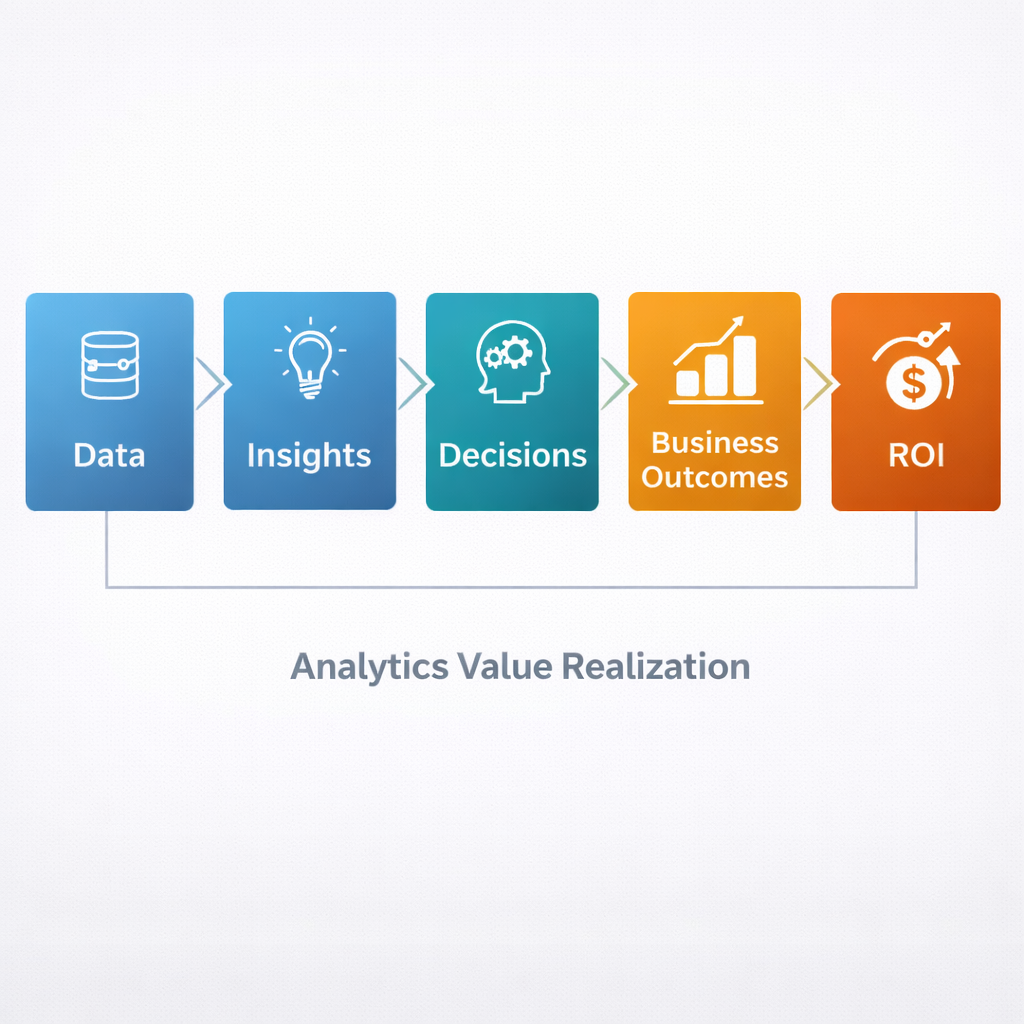
Analytics delivers ROI only when it informs decisions. Data-driven decision making is the bridge between insight and impact. If analytics does not influence choices, it does not generate value.

To strengthen this connection:

  • Identify key decisions analytics should support

  • Define what better decisions look like

  • Measure outcomes before and after analytics adoption

This approach clarifies how analytics improves judgment and reduces uncertainty across the organization.

Building Performance Measurement Frameworks for Analytics

Sustainable ROI measurement requires structure. Performance measurement frameworks provide consistency, clarity, and accountability. They help organizations track analytics impact over time rather than relying on one-off success stories.

A strong framework typically includes:

  • Clear objectives linked to business strategy

  • Defined metrics and benchmarks

  • Ownership and accountability

  • Regular review cycles

Frameworks ensure that analytics value is monitored continuously, not just during project launches.

Measuring Financial Impact Without Overcomplication

Financial impact is central to Measuring ROI of Analytics, but it does not require complex models. Leaders should focus on practical, defensible estimates.

Common financial impact methods include:

  • Cost reduction analysis

  • Revenue uplift estimation

  • Productivity gains valuation

  • Risk avoidance assessment

The goal is not precision but credibility. Clear assumptions and transparent logic matter more than perfect accuracy.

Evaluating the Business Impact of Analytics Across Functions

Analytics value varies across departments, but the measurement principles remain consistent. Understanding the business impact of analytics requires function-specific metrics tied to organizational goals.

Examples include:

  • Sales: improved conversion rates and pipeline accuracy

  • Marketing: reduced acquisition costs and higher lifetime value

  • Operations: lower cycle times and reduced waste

  • Finance: better forecasting and faster close cycles

Each function contributes to overall ROI when analytics improves outcomes at the operational level.

Measuring ROI of Analytics

Moving From Project-Based ROI to Portfolio Value

Many organizations measure analytics ROI one project at a time. While useful, this approach misses cumulative value. Measuring ROI of Analytics is more effective when viewed as a portfolio.

Portfolio measurement considers:

  • Combined impact across initiatives

  • Reusable data assets and models

  • Organizational learning and capability growth

This perspective highlights how analytics maturity compounds value over time.

Addressing Intangible and Long-Term Benefits

Not all analytics benefits are immediately measurable. Improved culture, faster learning, and better alignment are real but harder to quantify. Analytics value realization includes both tangible and intangible gains.

Ways to capture intangible value include:

  • Decision cycle time reduction

  • Improved cross-team alignment

  • Increased confidence in strategic choices

  • Reduced reliance on intuition alone

These benefits strengthen organizational resilience and adaptability.

Avoiding Common Mistakes in Analytics ROI Measurement

Even well-designed measurement efforts can fail if common pitfalls are ignored.

Overemphasizing Tool Adoption

Adoption does not equal impact. Focus on outcomes, not usage.

Ignoring Baselines

Without a baseline, improvement cannot be measured.

Treating ROI as a One-Time Exercise

Analytics value evolves. Measurement should be ongoing.

Avoiding these mistakes improves credibility and trust in analytics reporting.

Aligning Analytics Investments With Strategic Priorities

Analytics ROI improves when investments align with strategy. Random analytics projects dilute value and confuse stakeholders. Measuring ROI of Analytics requires intentional prioritization.

Leaders should:

  • Focus analytics on high-impact decisions

  • Limit low-value reporting

  • Regularly reassess priorities

Strategic alignment ensures analytics resources are used where they matter most.

Using External Benchmarks to Strengthen ROI Narratives

External research supports internal measurement efforts. Insights from organizations like Harvard Business Review help leaders understand how analytics-driven organizations outperform peers. Similarly, research published by McKinsey & Company highlights the competitive advantage gained through disciplined analytics investment.

External benchmarks reinforce internal findings and add credibility to ROI discussions with stakeholders.

Turning Measurement Into Action

Measurement alone does not create value. It must inform decisions about investment, scaling, and improvement. Measuring ROI of Analytics should lead to action.

Use ROI insights to:

  • Expand high-performing analytics initiatives

  • Improve underperforming ones

  • Sunset low-value efforts

  • Guide future investments

This feedback loop ensures analytics continues to deliver meaningful returns.

Embedding ROI Thinking Into Analytics Culture

Organizations that consistently realize analytics value embed ROI thinking into daily practices. Leaders model curiosity, accountability, and evidence-based discussion.

Cultural reinforcement includes:

  • Asking how analytics influenced decisions

  • Celebrating impact, not reports

  • Encouraging learning from failures

This mindset strengthens analytics value realization across teams.

How Engine Analytics Helps Organizations Prove Value

Proving analytics ROI requires expertise, structure, and experience. Teams often benefit from external guidance to accelerate results. The experts at Engine Analytics help organizations connect analytics initiatives to measurable business outcomes.

From defining ROI frameworks to aligning analytics with strategy, their analytics services support sustainable value creation.

Conclusion: Proving Value Beyond the Numbers

Analytics investment without impact is wasted potential. Measuring ROI of Analytics beyond vanity metrics gives leaders the clarity they need to justify spending, guide strategy, and build trust. By focusing on outcomes, aligning with decisions, and using structured measurement frameworks, organizations can clearly demonstrate the business value of analytics.

If you are ready to move beyond surface-level metrics and unlock real analytics value, explore how Engine Analytics can help. Connect with experts through the contact page and start building an analytics strategy that delivers measurable results.

Here’s Some Interesting FAQs for You

Measuring ROI of Analytics is the process of evaluating how analytics initiatives contribute to business outcomes such as revenue growth, cost reduction, and better decision-making.


The most important analytics ROI metrics focus on outcomes, including financial impact, efficiency improvements, risk reduction, and decision quality rather than usage statistics.


Analytics value realization varies, but organizations often see early benefits within months and greater returns as analytics maturity increases over time.