
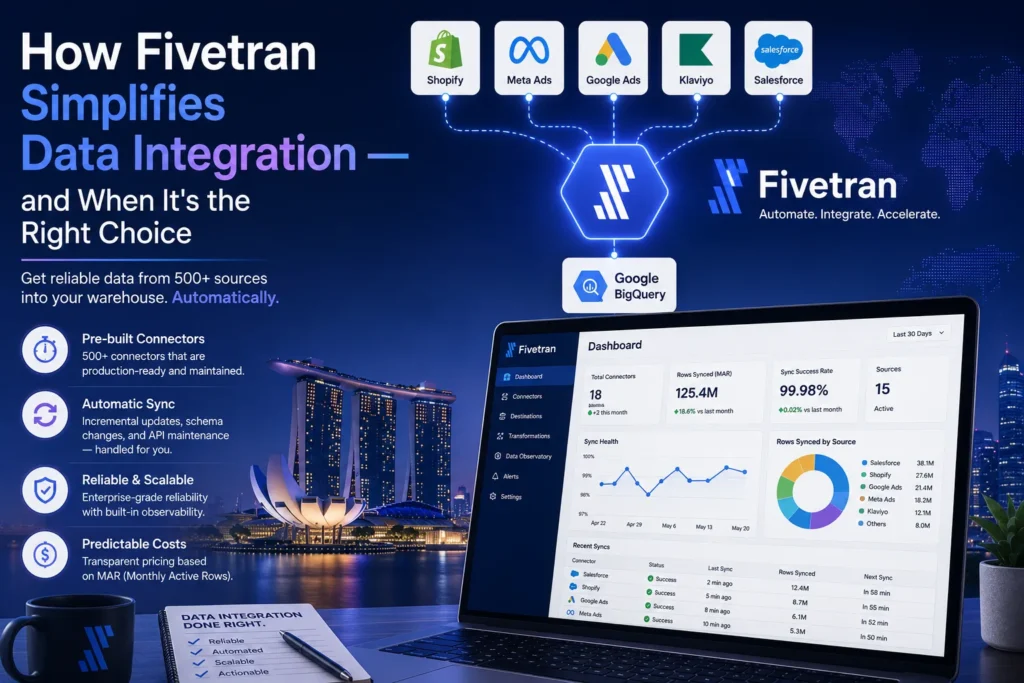
An operations analyst at a Singapore eCommerce business needs to combine data from Shopify, Meta Ads, Google Ads, Klaviyo, and Salesforce into a single reporting view in BigQuery. Her options are clear: build and maintain custom API connectors — and accept that every platform update will break something — or use a managed ELT tool like Fivetran that keeps the connectors maintained and lands the data automatically. She chooses Fivetran. For the five connectors she needs, it works exactly as advertised.
Six months later, the business acquires a logistics partner whose data lives in a proprietary warehouse management system with no Fivetran connector. The engineering team spends three weeks building a custom connector, discovering in the process that the custom connector development process is significantly more involved than the pre-built connector experience suggested. The Fivetran bill has also grown faster than expected, because one of the ad platform tables updates historical records retroactively and the MAR count is three times what the team projected.
Fivetran is a genuinely excellent product for the problem it was designed to solve. It is also frequently adopted by Singapore businesses without a clear understanding of where its model fits well and where it creates cost or coverage problems. This article covers what Fivetran does, where it excels, where it struggles, and how to evaluate whether it belongs in your data stack. It draws on the approach used by Engine Analytics, a data analytics company in Singapore that designs data integration architectures for businesses across eCommerce, SaaS, and enterprise sectors.
Every SaaS platform exposes its data through an API. Every API has authentication requirements, rate limits, pagination logic, schema conventions, and a history of breaking changes. Building a custom connector to a single platform is a few days of engineering work. Maintaining it as the platform evolves is an ongoing cost that never goes away. Multiply that across ten, fifteen, or twenty data sources and the engineering overhead of API maintenance becomes a significant tax on a team that would rather be building analytics.
Fivetran’s answer is to maintain those connectors so you don’t have to. Their engineering team tracks API changes for five hundred-plus sources, updates the connectors when platforms release new versions, handles authentication refreshes automatically, and manages the incremental sync logic that ensures only new or changed records are moved rather than full table dumps on every run. For businesses whose data sources are all on Fivetran’s supported list, this is a genuine engineering time saving that compounds significantly as the number of sources grows.
The ELT model — extract from source, load to destination, transform in destination — also aligns well with the modern data stack. Raw data lands in BigQuery or another cloud warehouse in a predictable schema. Transformation happens in the warehouse using dbt or SQL, applied to data that is already there and queryable. This separation between movement and transformation is one of the core principles covered in the article on what data engineering means for business leaders — and Fivetran implements the movement half of that separation reliably for supported sources.
Pre-built connector quality is Fivetran’s clearest strength. For major platforms — Salesforce, HubSpot, Shopify, Stripe, Google Ads, Meta Ads, Zendesk, Jira, and hundreds more — the connectors are production-grade, actively maintained, and handle the edge cases that custom connectors frequently miss: API pagination, rate limit handling, historical backfills, and incremental sync with change detection. For a business whose data sources are all on the supported list, setup time for a new connector is typically measured in minutes rather than days.
Schema normalisation means data arrives in BigQuery in a structured, queryable format without custom transformation logic at the ingestion stage. Fivetran handles type casting, nested field flattening, and basic schema evolution automatically. When a source platform adds a new field, Fivetran detects the schema change and adds the column to the destination table without breaking the existing pipeline. For analytics teams that want to focus on analysis rather than ingestion plumbing, this reduces the operational overhead of keeping data current significantly.
Fivetran’s Data Observatory provides lineage visibility — showing which downstream tables and dashboards depend on which connectors — and sync health monitoring that alerts when a connector fails or data freshness falls outside expected windows. For businesses running multiple connectors across multiple destinations, this observability layer is genuinely useful for maintaining confidence that the data arriving in your analytics environment is accurate and current.
Custom or proprietary data sources with no pre-built connector are the clearest limitation. Fivetran’s value proposition depends on its connector library covering your sources. When a critical data source — a proprietary ERP, a bespoke internal system, a regional platform with limited international adoption — is not on the supported list, the options are to build a custom connector using Fivetran’s connector SDK (which is significantly more engineering work than using a pre-built connector) or to handle that source with a different tool. Businesses with even one critical proprietary source need to account for this before committing to Fivetran as their primary integration platform.
High-volume data sources where MAR-based pricing becomes expensive need careful evaluation. Fivetran charges based on Monthly Active Rows — the number of rows that are synced or updated in a given month. For sources where historical records are frequently updated retroactively — ad platform data is the most common example, because performance metrics for past campaigns are recalculated as attribution windows close — the MAR count can be significantly higher than the number of new records suggests. A table with one million historical ad impressions that updates attribution data for the past thirty days on every sync can accumulate MAR counts that are multiples of what the team initially projected.
Real-time data requirements are also outside Fivetran’s primary design. Fivetran syncs on a scheduled basis — typically every hour for most plans, with more frequent options at higher tiers. For use cases where analytics need to reflect data that is minutes old rather than hours old, Fivetran’s batch sync model is not the right fit. And for very simple use cases — moving data from one or two sources that rarely change — the cost-benefit calculation often favours a lightweight alternative or a direct API call handled by a simple pipeline.
Fivetran’s MAR-based pricing model is logical but requires careful modelling before commitment. The core question is how many rows in your source tables change each sync cycle — not how many rows exist in total, but how many are new or updated. For relatively static data — customer master records, product catalogues, CRM contacts — MAR counts tend to be low and predictable. For event data, ad platform data, or any source that recalculates historical records retroactively, MAR counts can grow quickly and unpredictably.
The free tier is useful for evaluating connector quality and setup experience but does not represent production costs accurately for most businesses. The enterprise tier is negotiated rather than list-priced, which means the published pricing is a ceiling rather than a floor for higher-volume customers. If your projected MAR volume is significant, getting a specific quote and modelling costs against your actual data sources before signing an annual contract is essential.
Start by listing every data source you need to move and checking whether Fivetran has a maintained pre-built connector for each. If every source is supported, Fivetran is likely the fastest path to a working integration layer. If one or more critical sources require custom connectors, factor in the engineering cost and consider whether a tool that handles custom sources more naturally — such as Airbyte, which has a lower barrier to custom connector development — would be a better fit for your specific mix of sources.
Then model your MAR costs based on your actual data. Look at how many rows in each source table change between sync cycles, whether any sources update historical records retroactively, and what the resulting monthly MAR estimate would be across your full connector set. Compare that estimate against your available budget and against what alternative approaches — purpose-built pipelines for high-MAR sources, Fivetran for the rest — would cost in total.
The right data integration approach depends on your specific source mix, data volumes, latency requirements, and engineering capacity. View our data and AI services to understand how we approach integration architecture, explore our engagement plans, or get in touch and we can review your sources and model what the right integration architecture looks like for your business — including whether Fivetran is the right tool for all of it, part of it, or none of it.
Engine Analytics is a data and AI consultancy in Singapore that designs data integration architectures for businesses across eCommerce, SaaS, and enterprise sectors — matching the right tools to the right sources rather than defaulting to a single platform regardless of fit.
For SMEs whose data sources are all on Fivetran’s supported connector list and whose MAR volumes are predictable, yes — the engineering time saved on API maintenance typically justifies the cost. The risk is adopting it before understanding the MAR model for your specific sources. Model your costs against your actual data before committing to an annual plan.
Fivetran handles connector maintenance so your engineering team doesn’t have to — API updates, authentication refreshes, and schema evolution are managed automatically. Custom pipelines give you full control over logic, cost, and data handling but require ongoing engineering maintenance. For supported sources at moderate volume, Fivetran is almost always faster to implement and cheaper to operate. For unsupported or proprietary sources, custom pipelines are often the only viable option.
Yes. We assess whether Fivetran is the right fit for your specific sources and volumes, model your expected costs, and implement the integration architecture — whether that’s Fivetran across all your sources, Fivetran for some and custom pipelines for others, or an alternative tool entirely. Get in touch via the Engine Analytics contact page to start with a source and cost assessment.
— Engine Analytics | Singapore’s data analytics company — designing integration architectures that match the right tools to the right sources, so your data moves reliably without unexpected engineering or cost surprises.
