Data Mesh vs. Lakehouse vs. Data Fabric: Which Architecture Wins in 2026?

Table of Contents


Introduction: The Architecture Decision That Defines 2026

In 2026, data is no longer just a business asset; it is the backbone of competitive advantage, automation, and decision intelligence. Organizations across industries are modernizing how they collect, process, and activate information at scale. This shift has fueled intense debate around Data Mesh vs. Lakehouse vs. Data Fabric, three architectures shaping how enterprises design analytics platforms today. Each promises agility, scalability, and governance, yet each approaches the challenge from a fundamentally different angle.

As modern data architecture trends 2026 mature, leaders are realizing that architecture is no longer an IT-only concern. It directly impacts product velocity, customer experience, compliance, and cost efficiency. Choosing the wrong approach can slow innovation for years, while choosing the right one can unlock real-time insights and AI readiness.

This article breaks down Data Mesh vs. Lakehouse vs. Data Fabric in a practical, business-focused way. We will explore how each model works, where it excels, where it struggles, and which organizations benefit most. By the end, you will have a clear framework to align architecture decisions with your enterprise data management strategy.

Understanding the Context: Why Data Architecture Is Being Reimagined

Traditional centralized data warehouses were designed for a slower, more predictable world. Today’s enterprises operate with distributed teams, cloud-native systems, and continuous data generation. This has driven the emergence of Data Mesh vs. Lakehouse vs. Data Fabric as viable alternatives to legacy models.

Key forces shaping this evolution include:

  • Explosive growth in data sources and formats

  • Demand for real-time and self-service analytics

  • Increased regulatory and governance requirements

  • AI and machine learning workloads becoming mainstream

According to research from Gartner, modern architectures must balance decentralization with control to remain sustainable at scale. That balance is where these three approaches diverge most clearly.

What Is Data Mesh Architecture?

Core Principles of Data Mesh

Data mesh architecture is a socio-technical approach that treats data as a product and distributes ownership to domain teams. Instead of a centralized data team controlling pipelines, each business domain owns, publishes, and maintains its datasets.

Key principles include:

  • Domain-oriented ownership

  • Data as a product mindset

  • Self-serve data infrastructure

  • Federated computational governance

This model directly addresses organizational bottlenecks rather than purely technical ones. In the debate of Data Mesh vs. Lakehouse vs. Data Fabric, Data Mesh stands out as the most organizationally disruptive.

Benefits of Data Mesh

Data Mesh offers several advantages for large, complex organizations:

  • Faster delivery of analytics products

  • Better alignment between data and business context

  • Reduced dependency on centralized teams

  • Improved scalability across domains

For enterprises struggling with slow data pipelines and overloaded data teams, Data Mesh can be transformative.

Challenges and Limitations

However, Data Mesh is not a quick fix. Common challenges include:

  • High cultural and organizational change requirements

  • Need for strong data literacy across teams

  • Risk of inconsistent data quality without governance discipline

Without mature governance, Data Mesh can lead to fragmentation rather than agility.

What Is a Data Lakehouse Platform?

The Evolution from Warehouses and Lakes

A data lakehouse platform combines the flexibility of data lakes with the performance and governance of data warehouses. It allows organizations to store structured and unstructured data in one place while supporting BI, analytics, and machine learning workloads.

The Lakehouse gained traction through vendors like Databricks, which positioned it as a unified alternative to fragmented architectures. In the Data Mesh vs. Lakehouse vs. Data Fabric conversation, the Lakehouse is often seen as the most pragmatic option.

Key Advantages of the Lakehouse

Organizations adopting a Lakehouse typically benefit from:

  • Lower data duplication and storage costs

  • Unified analytics and AI workloads

  • Simplified architecture compared to multiple platforms

  • Strong performance with open formats

These strengths make the Lakehouse appealing for companies modernizing existing analytics stacks.

Where Lakehouse Falls Short

Despite its strengths, the Lakehouse is not perfect:

  • Centralized ownership can still create bottlenecks

  • Governance complexity increases at scale

  • Organizational agility depends heavily on operating models

The Lakehouse solves many technical problems but does not inherently address organizational ones.

Data Mesh vs. Lakehouse vs. Data Fabric


What Is a Data Fabric Framework?

Architecture Focused on Connectivity

A data fabric framework emphasizes intelligent integration, metadata, and automation across distributed systems. Rather than replacing existing platforms, it connects them using AI-driven data discovery, cataloging, and governance.

In Data Mesh vs. Lakehouse vs. Data Fabric, Data Fabric is the most integration-centric approach. It focuses on enabling access rather than redefining ownership or storage.

Strengths of Data Fabric

Data Fabric shines in complex enterprise environments by offering:

  • Unified data access across hybrid and multi-cloud systems

  • Strong metadata-driven governance

  • Reduced data movement and replication

  • Faster time to insight for distributed teams

Platforms like Snowflake increasingly incorporate fabric-like capabilities to enhance interoperability.

Limitations to Consider

However, Data Fabric also has constraints:

  • Can add architectural complexity

  • Depends heavily on metadata quality

  • May not replace the need for core data platforms

Data Fabric is often a complement rather than a complete replacement.

Data Mesh vs. Lakehouse vs. Data Fabric: A Side-by-Side Comparison

When evaluating Data Mesh vs. Lakehouse vs. Data Fabric, it’s important to look beyond surface-level definitions and understand how each architecture fundamentally approaches data ownership, scalability, and governance. While all three aim to solve modern data challenges, they do so from very different perspectives.

Architectural Focus

At their core, these architectures prioritize different problems:

  • Data Mesh: Built around organizational decentralization, Data Mesh shifts data ownership to business domains. Each domain team is responsible for creating, maintaining, and serving its own data products. The architecture emphasizes autonomy and accountability over centralized control.

  • Lakehouse: The Lakehouse model focuses on unified storage and compute. It merges the flexibility of data lakes with the performance and governance features of data warehouses, enabling analytics, BI, and AI workloads on a single platform.

  • Data Fabric: A Data Fabric acts as an intelligent integration layer. Rather than replacing existing systems, it connects them using metadata, automation, and policy-driven access, allowing users to discover and consume data across distributed environments.

This distinction in architectural focus is often the first deciding factor when comparing Data Mesh vs. Lakehouse vs. Data Fabric.

Best Fit Use Cases

Each architecture aligns better with specific organizational scenarios:

  • Data Mesh: Best suited for large enterprises with strong domain maturity, experienced data teams, and a culture of ownership. It works well when business units operate semi-independently and require speed without relying on a central data bottleneck.

  • Lakehouse: Ideal for analytics-driven organizations that are modernizing legacy data warehouses or data lakes. Companies focused on advanced analytics, reporting, and machine learning benefit from the Lakehouse’s simplicity and performance.

  • Data Fabric: A strong fit for hybrid enterprises with fragmented data estates spread across cloud, on-premises, and SaaS systems. Data Fabric excels when integration, consistency, and governance are bigger challenges than storage itself.

Understanding these use cases helps organizations avoid forcing an architecture into an environment where it cannot succeed.

Governance Approach

Governance is where these architectures differ most sharply:

  • Data Mesh: Uses federated governance, where global standards are defined centrally but enforced locally by domain teams. This balances autonomy with consistency but requires high data maturity.

  • Lakehouse: Relies on centralized governance. Policies, access controls, and quality rules are managed at the platform level, making it easier to enforce compliance and reduce risk.

  • Data Fabric: Leverages metadata-driven governance. Policies are embedded into data access and movement through intelligent metadata, enabling dynamic controls across distributed systems.

For organizations concerned about compliance, lineage, and auditability, governance often becomes the deciding factor in the Data Mesh vs. Lakehouse vs. Data Fabric discussion.

How Modern Data Architecture Trends 2026 Influence the Choice

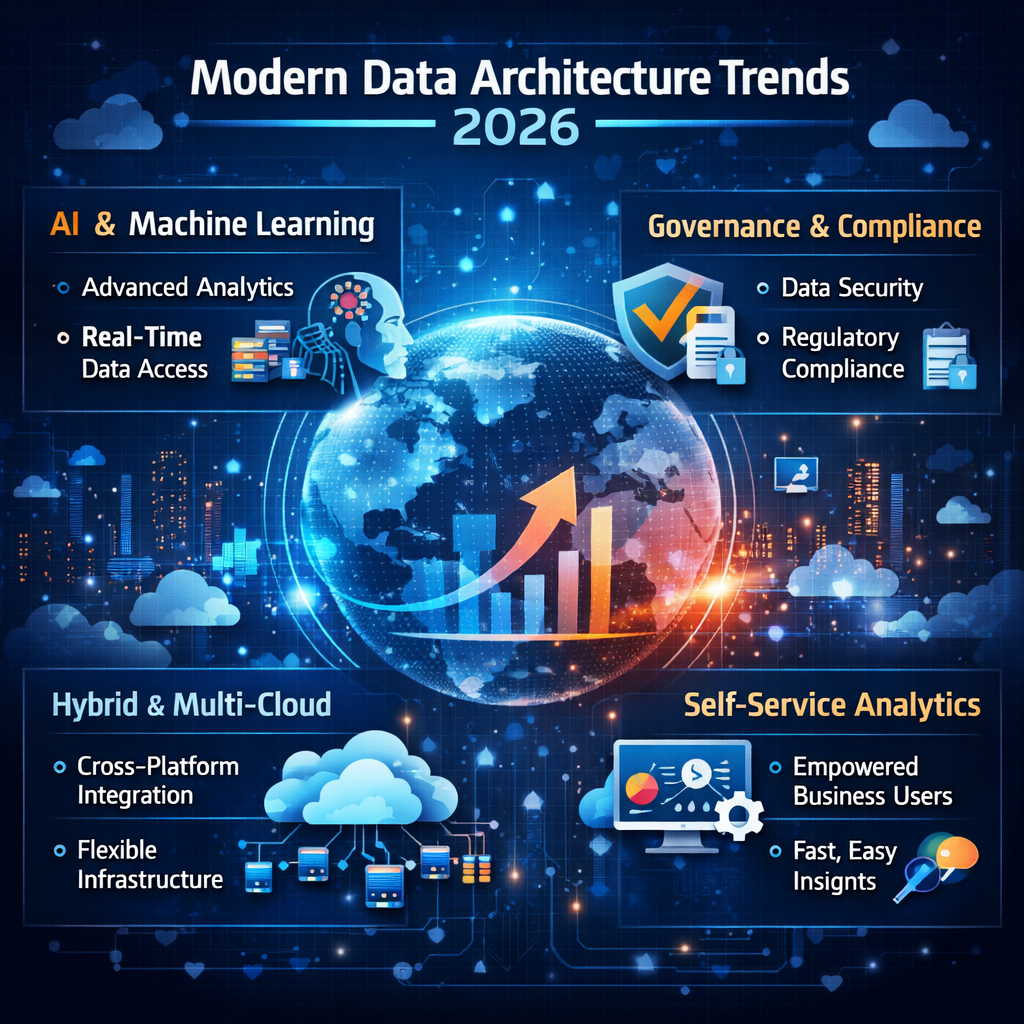
By 2026, data architecture decisions are shaped far more by business realities than by technology capabilities alone. While platforms continue to evolve rapidly, enterprises are under growing pressure to ensure their data ecosystems are scalable, compliant, and directly aligned with business outcomes. These modern data architecture trends 2026 are forcing organizations to rethink not only what architecture they adopt, but how they operationalize it.

One of the strongest drivers is the rise of AI and advanced analytics. Machine learning models and generative AI systems require consistent access to large volumes of high-quality data, spanning both structured and unstructured formats. Architectures that restrict access, introduce latency, or compromise data quality quickly become blockers to innovation. As a result, flexibility and data discoverability are now non-negotiable requirements.

At the same time, regulatory and compliance pressures continue to intensify across regions and industries. Regulations demand clearer data lineage, stronger access controls, and demonstrable accountability for how data is used. This makes governance-first thinking essential, not optional. Architectures that lack built-in mechanisms for transparency and control struggle to scale in regulated environments.

Finally, business expectations around self-service analytics have matured. Teams no longer want to wait weeks for reports or rely entirely on centralized data functions. However, they also recognize that uncontrolled self-service leads to inconsistent metrics and loss of trust. The challenge in 2026 is enabling autonomy without chaos.

According to industry research from Gartner, organizations investing in modern data architectures are prioritizing AI readiness, governance, and scalable integration to support long-term growth.

Taken together, these trends clearly show why no single architecture universally wins. Instead, organizations are increasingly adopting hybrid strategies that borrow strengths from multiple models, tailoring their approach to specific workloads, teams, and risk profiles.

Data Mesh vs. Lakehouse vs. Data Fabric


Choosing the Right Enterprise Data Management Strategy

When evaluating Data Mesh vs. Lakehouse vs. Data Fabric, the most successful organizations start with organizational readiness rather than vendor promises or architectural buzzwords. Technology alone cannot fix structural issues in ownership, skills, or governance.

Leadership teams should begin by asking foundational questions that reveal where the organization truly stands:

  • How mature are your domain teams?
    Can they realistically own, document, and maintain high-quality data products over time, or do they still depend heavily on centralized expertise?

  • Do you need unified analytics performance or federated ownership?
    Some organizations prioritize speed, consistency, and centralized optimization, while others value autonomy and local decision-making.

  • What is the primary bottleneck today?
    Is it data integration across systems, enforcing governance and compliance, or scaling storage and compute for analytics and AI?

In practice, many enterprises discover that a blended approach delivers the best results. A common and effective pattern in 2026 is to use a Lakehouse as the core analytics and AI platform, providing unified storage and performance. A Data Fabric layer is then added to connect distributed systems, manage metadata, and enforce governance across environments. Finally, selective Data Mesh principles are applied to empower high-maturity domains with ownership and accountability.

This approach balances innovation with control, allowing organizations to evolve incrementally rather than through disruptive, high-risk transformations.

To explore tailored data architecture solutions aligned with your business goals, visit the services page .

Or connect directly with experts through the contact page.

Real-World Adoption Patterns in 2026

By 2026, real-world adoption patterns are becoming increasingly clear across industries, revealing how theory translates into practice.

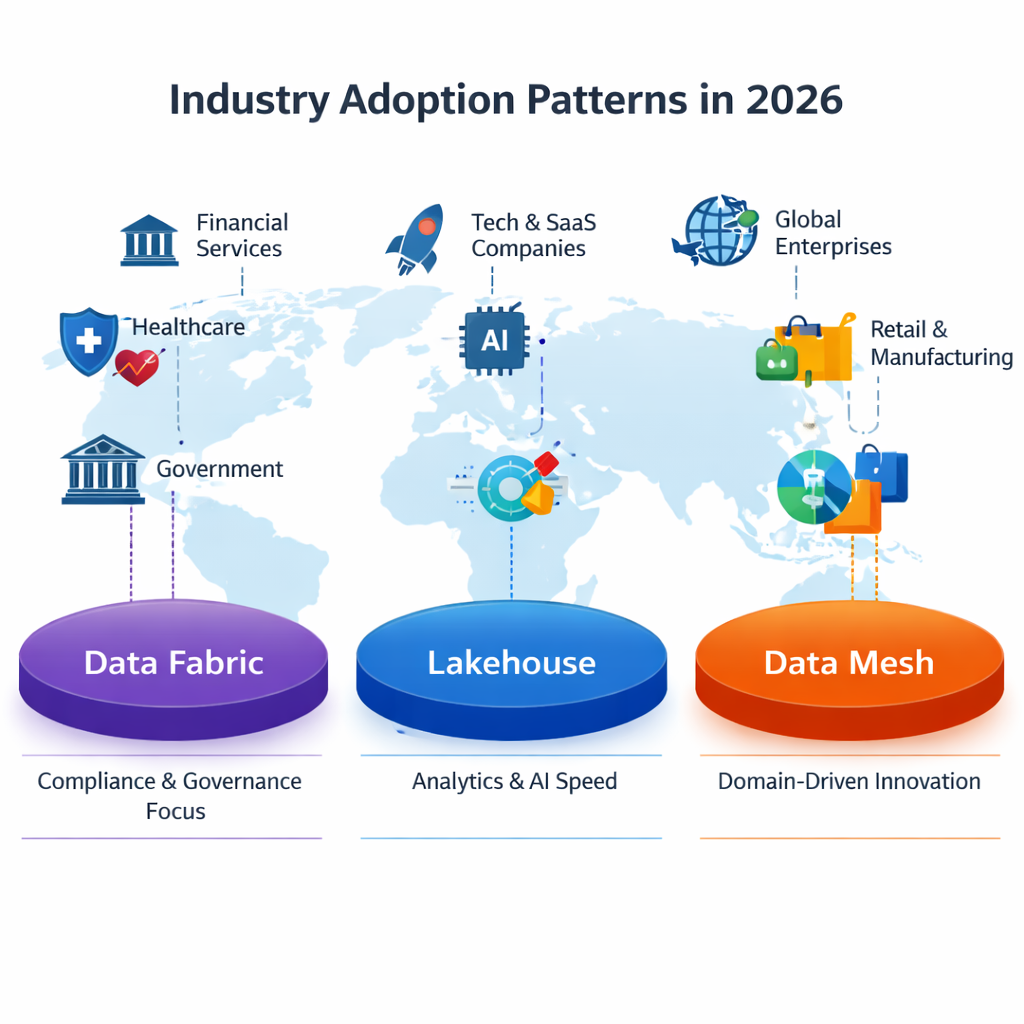
Financial services, healthcare, and government organizations often gravitate toward Data Fabric–led strategies. In these environments, regulatory compliance, auditability, and data lineage take precedence, making metadata-driven governance and controlled access essential.

Digital-native and technology-driven companies tend to favor Lakehouse architectures. Their focus on real-time analytics, AI experimentation, and rapid product iteration aligns well with the performance and flexibility of unified data platforms.

Large global enterprises are selectively adopting Data Mesh principles, but only where domain maturity is high. Rather than a full-scale rollout, Data Mesh is often applied to specific business units or product lines where ownership models are already strong.

Across all sectors, the key insight is consistent: success is not about choosing the “best” architecture in isolation. It is about choosing the right combination, aligned with business objectives, organizational culture, and the ability to govern data responsibly at scale.


Conclusion: There Is No Single Winner, Only the Right Fit

The debate around Data Mesh vs. Lakehouse vs. Data Fabric is not about declaring a universal winner. In 2026, winning architectures are those aligned with business reality, culture, and long-term goals.

Data Mesh empowers teams, Lakehouse simplifies analytics, and Data Fabric connects complexity. The smartest organizations blend these approaches into a cohesive enterprise data management strategy.

If you are planning your next data transformation, explore expert guidance and real-world solutions at Engine Analytics. The right architecture choice today will define how confidently your organization competes tomorrow.

Here’s Some Interesting FAQs for You

No. In 2026, Data Mesh is not replacing Lakehouse platforms—it is complementing them. Data Mesh is primarily an organizational and operating model, not a storage or processing platform. Most enterprises still rely on a Lakehouse to provide scalable storage, high-performance analytics, and AI workloads. Data Mesh principles are then layered on top, allowing domain teams to own and manage data products while leveraging the Lakehouse as the shared technical foundation. This combination offers both decentralization and efficiency without duplicating infrastructure.

Yes. A Data Fabric framework is specifically designed to work alongside existing data warehouses, lakes, and cloud platforms rather than replace them. It acts as an intelligent integration and governance layer, connecting disparate systems through metadata, automation, and policy-driven access. This makes Data Fabric particularly valuable in hybrid and multi-cloud environments where data is distributed across multiple technologies. Organizations can modernize access, governance, and visibility without the cost or risk of a full platform migration.

Lakehouse platforms are currently the strongest foundation for AI and machine learning workloads because they support large-scale data processing, open data formats, and unified analytics pipelines. However, AI success also depends on data quality, lineage, and discoverability. This is where Data Fabric capabilities add significant value by improving metadata management, governance, and trust. In practice, many organizations combine a Lakehouse for performance with Data Fabric features for control, creating an AI-ready architecture that scales responsibly.