Table of Contents
Enterprises today are drowning in data but starving for insight. As organizations scale, diversify data sources, and demand real-time intelligence, traditional centralized data architectures often struggle to keep up. This is where the debate around Data Mesh vs. Data Fabric comes into focus.
Both approaches promise to modernize enterprise data architecture, improve accessibility, and support advanced analytics. However, they are fundamentally different in philosophy, design, and execution. Choosing between Data Mesh vs. Data Fabric is not about trends—it’s about aligning architecture with your business model, operating culture, and long-term data strategy.
In this guide, we break down Data Mesh vs. Data Fabric in practical terms, explore when each approach works best, and help you determine the right path for your enterprise.
Enterprises today are drowning in data but starving for insight. As organizations scale, diversify data sources, and demand real-time intelligence, traditional centralized data architectures often struggle to keep up. This is where the debate around Data Mesh vs. Data Fabric comes into focus.
Both approaches promise to modernize enterprise data architecture, improve accessibility, and support advanced analytics. However, they are fundamentally different in philosophy, design, and execution. Choosing between Data Mesh vs. Data Fabric is not about trends—it’s about aligning architecture with your business model, operating culture, and long-term data strategy.
In this guide, we break down Data Mesh vs. Data Fabric in practical terms, explore when each approach works best, and help you determine the right path for your enterprise.
Why Enterprise Data Architecture Needs a Rethink
Modern organizations operate in increasingly complex environments:
Multiple business units with independent data needs
Cloud, on-prem, and hybrid systems
Real-time analytics expectations
AI and advanced analytics use cases
Traditional monolithic data platforms often become bottlenecks. This has pushed enterprises to explore new enterprise data architecture models focused on agility, scalability, and ownership.
The Data Mesh vs. Data Fabric conversation emerged as a response to these challenges, offering two distinct approaches to modern data management.
What Is Data Mesh?
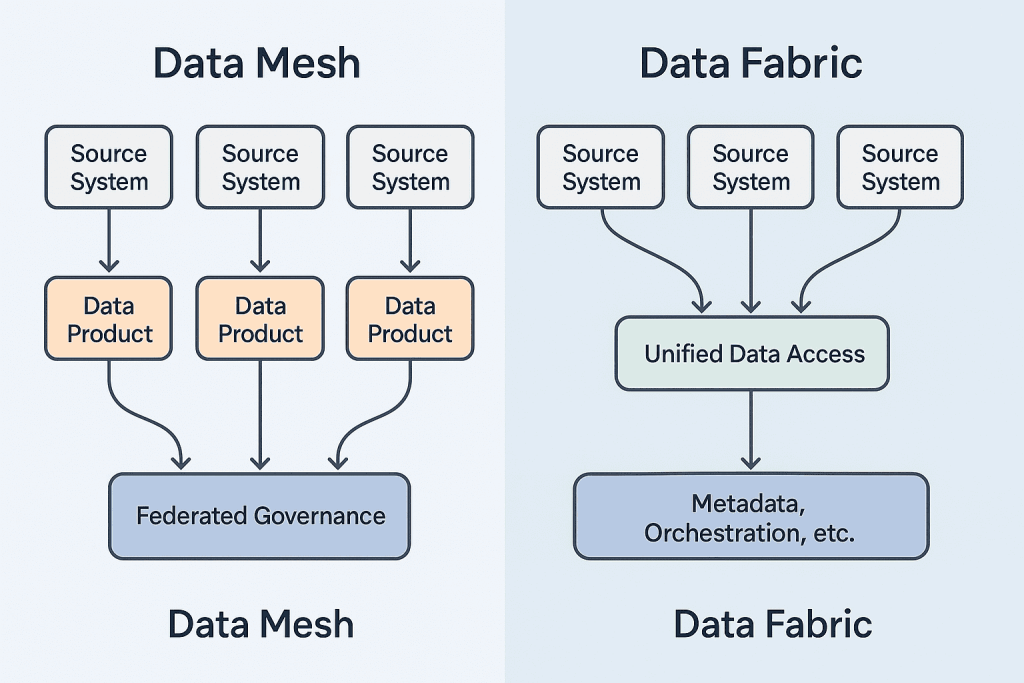
Data Mesh architecture is a decentralized approach to data management. Instead of treating data as a centralized IT asset, Data Mesh treats data as a product owned by the business domains that generate it.
Core Principles of Data Mesh Architecture
Data Mesh is built on four foundational concepts:
Domain-oriented ownership
Each business domain owns and manages its data products.Data as a product
Data is curated, documented, and designed for consumption.Self-serve data infrastructure
Platforms provide standardized tools for domains to manage data independently.Federated governance
Governance is enforced through shared standards rather than central control.
In the Data Mesh vs. Data Fabric comparison, Data Mesh prioritizes organizational change and accountability over technology alone.

What Is Data Fabric?
Data Fabric architecture focuses on creating a unified data layer that connects disparate systems through automation, metadata, and intelligent integration.
Rather than decentralizing ownership, Data Fabric emphasizes orchestration and connectivity across the enterprise.
Key Characteristics of Data Fabric Architecture
Unified data access layer
Extensive metadata management
Automation powered by AI/ML
Strong focus on integration and interoperability
In the Data Mesh vs. Data Fabric debate, Data Fabric is more technology-driven, aiming to simplify complexity without restructuring teams.
Data Mesh vs. Data Fabric: Architectural Comparison
Understanding Data Mesh vs. Data Fabric requires examining how each approach handles core enterprise needs.
1. Ownership and Governance
Data Mesh architecture distributes ownership to business domains
Data Fabric architecture maintains centralized governance with automated controls
If your organization values autonomy and accountability, Data Mesh may align better. If centralized oversight is critical, Data Fabric often fits more naturally.
2. Scalability and Growth
Data Mesh scales through organizational structure
Data Fabric scales through technology and automation
In large enterprises with many semi-independent teams, Data Mesh vs. Data Fabric often favors Data Mesh for long-term scalability.
3. Data Integration Strategy
A strong data integration strategy is essential for both approaches:
Data Mesh integrates through standardized data products
Data Fabric integrates through intelligent connectors and pipelines
Organizations with heavy legacy integration needs often lean toward Data Fabric.
4. Speed of Implementation
Data Fabric can often be implemented faster initially
Data Mesh requires cultural and operating model changes
In Data Mesh vs. Data Fabric, time-to-value can be a deciding factor.
When Data Mesh Makes Sense
Data Mesh is not a universal solution. It works best under specific conditions.
Ideal Scenarios for Data Mesh Architecture
Large, complex enterprises
Strong domain expertise across teams
Mature data culture
Need for high autonomy and agility
In these environments, Data Mesh vs. Data Fabric usually tilts toward Data Mesh for sustainable modern data management.
When Data Fabric Is the Better Choice
Data Fabric excels when organizations need consistency and control without major organizational change.
Ideal Scenarios for Data Fabric Architecture
Centralized IT governance models
Heavy reliance on legacy systems
Need for rapid integration
Limited data engineering resources
For many enterprises, Data Mesh vs. Data Fabric decisions start with Data Fabric as a stepping stone toward modernization.
Data Mesh vs. Data Fabric in Practice
In reality, the Data Mesh vs. Data Fabric discussion is rarely binary. Many enterprises adopt hybrid approaches.
Hybrid Enterprise Data Architecture
Some organizations:
Use Data Fabric for integration and metadata
Apply Data Mesh principles for ownership and data products
This blended approach supports flexibility while maintaining governance—an increasingly common pattern in enterprise data architecture.
Organizational Impact: A Critical Difference
One of the most overlooked aspects of Data Mesh vs. Data Fabric is organizational readiness.
Data Mesh requires changes in roles, responsibilities, and incentives
Data Fabric primarily impacts technology stacks
At Engine Analytics, we often advise clients to assess organizational maturity before committing to a specific architecture. This is where strategic consulting and analytics services become essential.
You can explore how we support architecture planning on our services page.
Modern Data Management Beyond Architecture
Architecture alone does not guarantee success. Effective modern data management also depends on:
Data quality and observability
Clear ownership models
Business-aligned metrics
Scalable analytics platforms
Whether you choose Data Mesh vs. Data Fabric, success depends on execution, governance, and continuous improvement.
Technology Considerations in Data Mesh vs. Data Fabric
Common Technologies Supporting Data Mesh
Cloud data platforms
Data catalogs
API-based data sharing
Domain-level analytics tools
Common Technologies Supporting Data Fabric
Integration platforms
Metadata-driven orchestration
AI-powered data management tools
Technology selection should always follow strategy, not the other way around—a core principle in enterprise data architecture.
Choosing Between Data Mesh vs. Data Fabric
To decide between Data Mesh vs. Data Fabric, ask these questions:
How mature is our data culture?
Do we have strong domain ownership?
How complex is our integration landscape?
How much governance is required centrally?
What is our long-term data integration strategy?
Answering these honestly often makes the right choice clear.
Industry experts widely agree that the Data Mesh vs. Data Fabric decision is less about choosing a “better” architecture and more about aligning data strategy with organizational reality. Thought leaders from firms like Thought Works emphasize that Data Mesh succeeds when enterprises are ready to decentralize ownership and treat data as a product, while analysts at Gartner highlight Data Fabric’s strength in unifying complex ecosystems through metadata-driven integration and automation. Together, these perspectives reinforce that modern enterprise data architecture is most effective when it balances technology capabilities with governance, culture, and long-term scalability goals rather than relying on a one-size-fits-all model.
How Engine Analytics Helps Enterprises Decide
At Engine Analytics, we help organizations navigate complex architecture decisions with clarity. Our approach focuses on aligning enterprise data architecture with business outcomes—not just technology trends.
We support:
Data architecture assessments
Data Mesh and Data Fabric strategy design
Data integration strategy development
Analytics enablement and execution
If you’re evaluating Data Mesh vs. Data Fabric, our team can help you choose—and implement—the right approach with confidence.
Final Thoughts: Making the Right Architecture Choice
Choosing between Data Mesh vs. Data Fabric is a strategic decision that shapes how your enterprise uses data for years to come. Both architectures offer powerful benefits when aligned with the right organizational model and execution strategy.
The key is not following hype—but choosing the architecture that supports scalability, governance, and business value.
If your organization is ready to modernize its data foundation, visit the Engine Analytics homepage to learn how we help enterprises turn complex data into actionable insights.
Have questions or want expert guidance? Reach out through our contact page to start the conversation.
Here’s Some Interesting FAQs for You
What is the main difference between Data Mesh vs. Data Fabric?
The core difference in Data Mesh vs. Data Fabric lies in how data ownership and responsibility are handled. Data Mesh decentralizes data ownership to individual business domains, treating data as a product managed by the teams closest to it. In contrast, Data Fabric centralizes data access through an intelligent integration layer that connects systems using metadata, automation, and orchestration, while ownership typically remains with central data teams.
Can Data Mesh and Data Fabric be used together?
Yes. Many enterprises successfully combine both approaches. In practice, Data Fabric is often used to handle data integration, connectivity, and governance at scale, while Data Mesh principles are applied to domain ownership and data product thinking. This hybrid enterprise data architecture allows organizations to benefit from centralized integration while still empowering business teams.
Which approach is better for modern data management?
There is no universal answer. The right choice in Data Mesh vs. Data Fabric depends on factors such as organizational maturity, data culture, technical complexity, and long-term analytics goals. Enterprises with strong domain ownership and data literacy may lean toward Data Mesh, while those needing faster integration and centralized control often start with Data Fabric or a hybrid model for effective modern data management.