
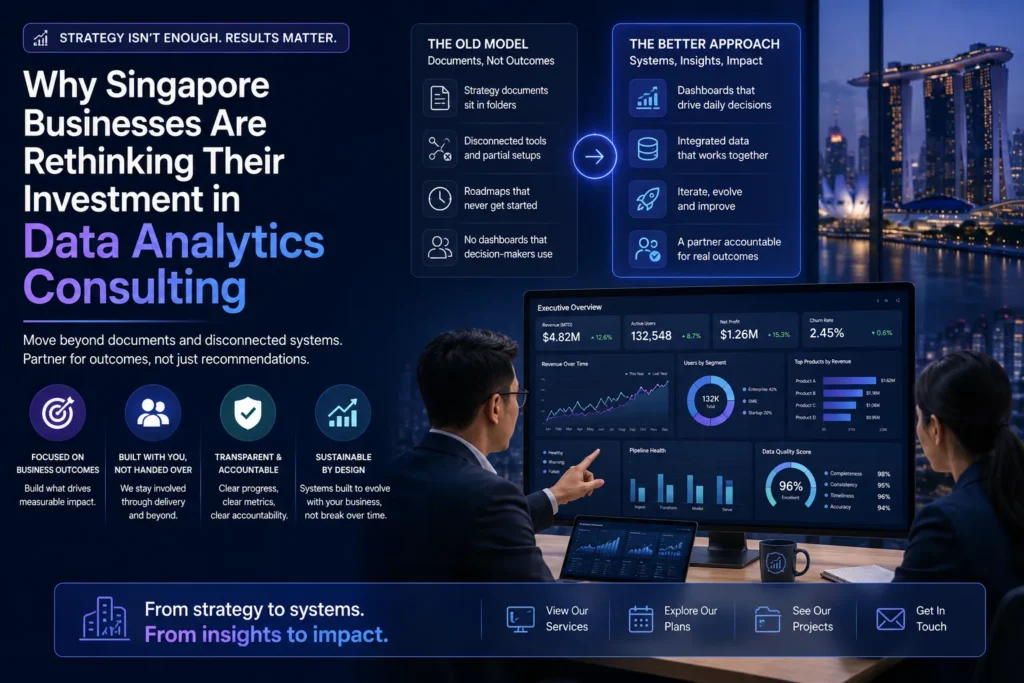
A Singapore fintech business hired a data analytics consultancy eighteen months ago for a twelve-week strategy engagement. The deliverable was a sixty-page document: a recommended tech stack, a data governance framework, an implementation roadmap with quarterly milestones, and a set of KPI definitions the business should be tracking. The consultants presented it, answered questions, and left.
Twelve months later, the tech stack recommendations are partially installed but not connected to each other. The governance framework is referenced in internal documentation but has not changed how anyone actually handles data. The implementation roadmap has never been formally started. The KPI definitions sit in a shared folder that nobody has opened in three months. The engagement cost six figures. The organisation has no dashboards that a decision-maker relies on daily. The ROI is, by any honest accounting, zero.
This is not an isolated story. It is the pattern that a growing number of Singapore businesses are recognising when they look back at analytics consulting engagements that produced documents but not systems, strategies but not outcomes. The rethink is not about whether data analytics is valuable — it clearly is. It is about whether the traditional consulting model is the right way to extract that value. This article covers why the conventional model underdelivers and what a better approach looks like. It draws on the perspective of Engine Analytics, a data analytics company in Singapore that builds analytics infrastructure rather than producing recommendations about it.
The traditional analytics consulting model was designed for a different era. When data infrastructure required significant custom engineering, specialised hardware, and months of setup work, the case for a strategy-first engagement was clear: before investing that much time and money in implementation, you needed a careful plan. The strategy phase was proportionate to the implementation cost.
The modern data stack has changed that equation significantly. A cloud data warehouse, a managed ELT tool, a transformation framework, and a BI layer can be assembled and producing useful output in weeks, not months. The implementation cost and timeline have both dropped dramatically. But the traditional consulting model has not adapted to match. Businesses are still paying for twelve-week strategy phases before any implementation begins — and the strategy is still being handed off to internal teams who were not part of building it.
Singapore’s business community is also maturing in its data literacy. Leaders who commissioned analytics engagements two or three years ago have now seen enough outcomes — or lack of them — to ask sharper questions before committing budget. The questions they are now asking are covered in detail in the guide to what makes a great data analytics partner, which addresses the specific things worth evaluating before engaging an analytics consultancy.
Strategy documents do not build dashboards. This sounds obvious, but the traditional engagement model consistently treats the strategy deliverable as the primary output — the thing that demonstrates the engagement’s value. A well-structured sixty-page document with a clear technology recommendation and an implementation roadmap looks like value. It does not produce a single dashboard that a decision-maker opens at nine in the morning to understand what happened yesterday.
Recommendations made without implementation ownership are not accountable to outcomes. When the consultancy recommends a tech stack and then leaves, the success or failure of the implementation falls on an internal team that was not involved in making the recommendation. When the implementation runs into problems — data quality issues the strategy didn’t anticipate, integration complexity that the recommendation underestimated, internal capacity that proved insufficient — there is no one accountable for making it work. The consultancy delivered its contractual obligation. The business is left with a partially implemented system.
The handoff model assumes that internal teams can successfully take over systems they did not build. This assumption is frequently wrong. Data pipelines require understanding of the specific decisions made during implementation — why a particular table is structured a certain way, what edge cases the transformation logic is handling, what monitoring is in place and what it alerts on. Without that knowledge, internal teams maintaining a handed-off system are always one undocumented decision away from breaking something they cannot diagnose.
The shift in what Singapore businesses want from analytics consulting is visible in how the conversations at initial meetings have changed. Three years ago, the typical brief was: “we need a data strategy.” Today, the typical brief is: “we need dashboards that our team actually uses, and we need someone who will build them rather than tell us how to build them.” The emphasis has moved from planning to delivery, and from one-time engagements to ongoing partnerships.
Embedded analytics partnership — where the consultancy continues to work with the business through implementation, iteration, and evolution — is increasingly the model businesses ask for rather than accept as an upgrade. The rationale is simple: a consultancy that remains involved through implementation is accountable for the system working, not just for the recommendation being coherent. That accountability changes the quality of the recommendation, because it is made by people who will be responsible for delivering against it.
Transparency about what is being built, for whom, and what success looks like is also something businesses are demanding more explicitly. The complete guide to data analytics consulting in Singapore covers the questions worth asking before committing to any analytics engagement — including how to evaluate whether a consultancy’s past work actually produced systems that are still in use, or documents that are no longer referenced.
Ask to see live dashboards built for other clients — not case study PDFs or screenshots, but reports that are currently in use and that someone in that business opens regularly. A consultancy confident in its implementation quality will have no hesitation sharing examples. A consultancy whose primary deliverable is strategic documentation will find this question difficult to answer.
Ask who builds the pipelines and writes the transformation logic. In some consulting models, senior consultants design the architecture and junior staff or offshore teams implement it — with the result that the people accountable for the recommendation are different from the people responsible for making it work. Understanding the composition of the team that will actually do the implementation work, not just the team that attends the discovery calls, matters significantly.
Ask what happens to the system when the engagement ends. A system that requires the consultancy to remain involved to function is not an asset — it is a dependency. A system that is well-documented, built on standard tools, and handed over with enough institutional knowledge that an internal team or a replacement partner can maintain it is what you are actually paying for. The answer to this question tells you a great deal about how the consultancy thinks about its relationship with clients.
It starts with a diagnostic rather than a proposal. Before recommending technology or architecture, the right first step is understanding the actual state of the data: what sources exist, what quality problems are present, what questions the business most needs to answer, and what internal capacity exists to maintain whatever gets built. A proposal made without this understanding is a guess. A proposal made with it is a plan.
The first deliverable is something the business can use — a working dashboard, a connected pipeline, a functioning report — not a document describing what those things should look like. Early delivery builds trust, surfaces the practical problems that discovery calls cannot anticipate, and gives the business something concrete to respond to. Iteration based on real use is faster and more accurate than iteration based on a strategy review meeting.
Ongoing engagement covers monitoring, iteration, and evolution as the business changes. Data infrastructure that is built and left alone degrades. Sources change. Business questions evolve. New data becomes available. The organisations that get sustained value from analytics investment are the ones with an ongoing relationship with a team that understands their systems and continues to develop them — not the ones that commissioned a strategy eighteen months ago and have been maintaining it alone since.
If your organisation has invested in analytics consulting and found the outcomes disappointing, or if you are evaluating partners and want to understand what a build-first engagement model looks like in practice, we are happy to walk through it. View our data and AI services, explore our engagement plans, see our project portfolio, or get in touch directly.
Engine Analytics is a data analytics company in Singapore that builds analytics infrastructure — pipelines, data layers, and dashboards that decision-makers actually use — rather than producing recommendations about what that infrastructure should look like.
Because the deliverable is typically a strategy document rather than a working system. Documents do not produce dashboards. The organisations that get value from analytics investment are the ones where the same team that made the recommendations is responsible for implementing them — and accountable if they don’t work.
Three things: ask to see live dashboards currently in use at other clients, ask who specifically will build the pipelines and transformation logic, and ask what the system looks like when the engagement ends. The answers to those three questions reveal more about how a consultancy operates than any proposal document will.
We build rather than advise. The first engagement deliverable is always a working system — a connected pipeline, a functioning dashboard — not a document. We stay involved through implementation and offer ongoing plans for monitoring and iteration. Our accountability is to systems that work, not to documents that were delivered. Get in touch via the Engine Analytics contact page to discuss what that looks like for your specific situation.
— Engine Analytics | Singapore’s data analytics company — building the systems that analytics strategies describe, rather than producing strategies that someone else has to build.
