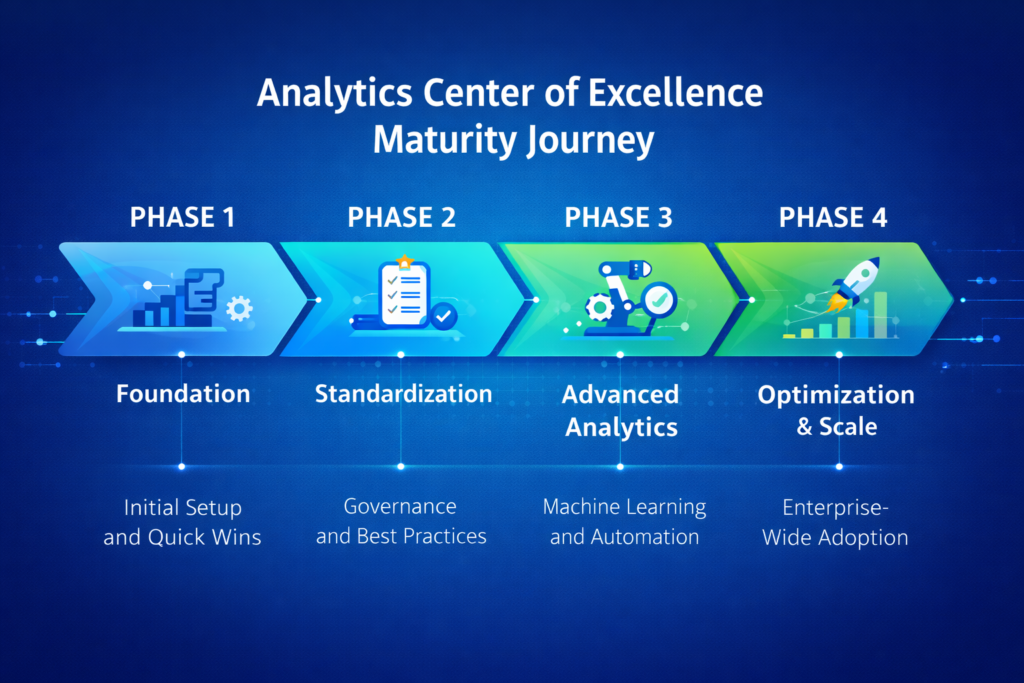
Organizations today are under constant pressure to turn growing volumes of data into meaningful insights. While many companies invest heavily in analytics tools and platforms, far fewer succeed in delivering consistent, enterprise-wide value. This gap often exists because analytics initiatives are fragmented, poorly governed, or disconnected from business priorities. Establishing an Analytics Center of Excellence is one of the most effective ways to overcome these challenges and create a scalable, sustainable analytics capability.
An Analytics Center of Excellence acts as a centralized hub for standards, expertise, and innovation, enabling organizations to align data efforts with strategic objectives. Rather than operating as a siloed technical team, it brings together people, processes, and technology to drive measurable business outcomes. When done right, it accelerates decision-making, improves data quality, and fosters a truly data-driven culture across the enterprise.
However, building a successful CoE is not without challenges. Many organizations struggle with unclear ownership, resistance to change, or unrealistic expectations. This article explores best practices for building an effective Analytics Center of Excellence, common pitfalls to avoid, and practical guidance for long-term success. Whether you are starting from scratch or refining an existing initiative, these insights will help you build a CoE that delivers real business value.
What Is an Analytics Center of Excellence?
An Analytics Center of Excellence is a cross-functional structure that governs, enables, and scales analytics across an organization. It defines how data is managed, analyzed, and used, ensuring consistency while still allowing flexibility for business teams. Unlike traditional analytics teams that focus solely on reporting, a CoE integrates strategy, governance, and advanced analytics capabilities.
At its core, the CoE serves as a bridge between business and technology. It ensures analytics initiatives are aligned with business goals, supported by a robust data governance framework, and executed using best-in-class methodologies. This approach reduces duplication of effort, improves insight quality, and increases trust in data.
A mature Analytics Center of Excellence typically supports multiple use cases, including operational reporting, predictive analytics, and strategic decision support. It also plays a key role in defining the organization’s business intelligence strategy and ensuring analytics investments generate measurable returns.
Why Organizations Need an Analytics Center of Excellence
As organizations grow, analytics often evolves organically within departments. While this decentralized approach offers speed initially, it quickly leads to inconsistencies, conflicting metrics, and governance gaps. An Analytics Center of Excellence addresses these issues by providing structure and shared accountability.
Industry research consistently shows that analytics initiatives fail not because of technology limitations, but due to weak governance and lack of strategic alignment, a challenge widely highlighted in analytics governance research by Gartner.
Key drivers for establishing a CoE include:
Increasing demand for reliable, real-time insights
Complex data environments requiring enterprise data management
The need for consistent metrics and definitions
Growing regulatory and compliance requirements
Pressure to maximize ROI from analytics investments
By centralizing standards and best practices, a CoE enables organizations to scale analytics without sacrificing quality or control. It also supports collaboration across teams, helping analytics move from descriptive reporting to strategic value creation.
Core Components of a Successful Analytics CoE
Governance and Standards
Strong governance is the foundation of any effective Analytics Center of Excellence. This includes clear policies for data access, quality, security, and lifecycle management. A well-defined data governance framework ensures that data is accurate, trusted, and compliant with regulatory requirements.
Governance should not be overly restrictive. Instead, it should balance control with agility, enabling teams to innovate while maintaining consistency. Clear ownership roles, such as data owners and stewards, are essential for accountability.
Operating Model and Structure
An effective analytics operating model defines how the CoE interacts with business units, IT, and leadership. Common models include centralized, federated, and hybrid approaches. Each has advantages, and the right choice depends on organizational size, culture, and maturity.
A hybrid model is often most effective, combining centralized standards with decentralized execution. This allows business teams to remain agile while benefiting from shared expertise and infrastructure provided by the Analytics Center of Excellence.