The BI world is going through a quiet restructuring.
Not a hype cycle.
Not an AI buzzwave.
A structural reset.
Every company I’ve worked with in the past two years, from global tech to regional mid-market teams, is doing the same thing:
Shrinking BI headcount while increasing BI expectations.
This isn’t a cost-cutting trend.
It’s an efficiency correction.
Let’s be direct:
the traditional BI model is broken.
1. The Old BI Model Failed Under Its Own Weight
The classic BI structure was built for a different era:
1 manager
3 analysts
2 data engineers
1 dashboard specialist
It sounded solid on paper.
In reality, it created:
endless handovers
bottlenecks
duplicated work
“data concierge” behavior
analysts stuck in operational loops
dashboards nobody reads
teams drowning in ad-hoc requests
Everyone owned 10% of the process.
Nobody owned the outcome.
2. Meanwhile, Expectations Exploded
Leadership wanted:
faster insights
cleaner KPI definitions
fewer errors
automated QBR/MBR cycles
cross-regional alignment
more dashboards
more integration
more transparency
BI was still working like a human ETL pipeline.
The mismatch became unsustainable.
By 2025, CFOs were asking a new question:
“Why do we have 6–8 people doing work a pipeline can run nightly?”
And they’re right.
3. The New BI Model Is Lean – and Far More Powerful
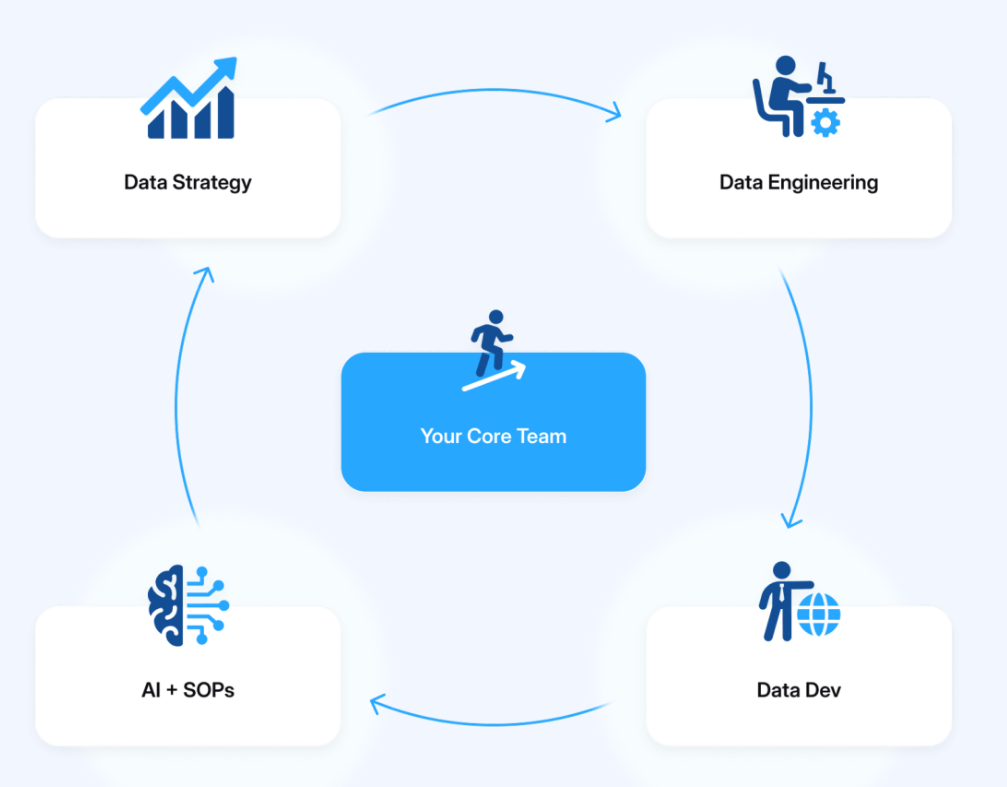
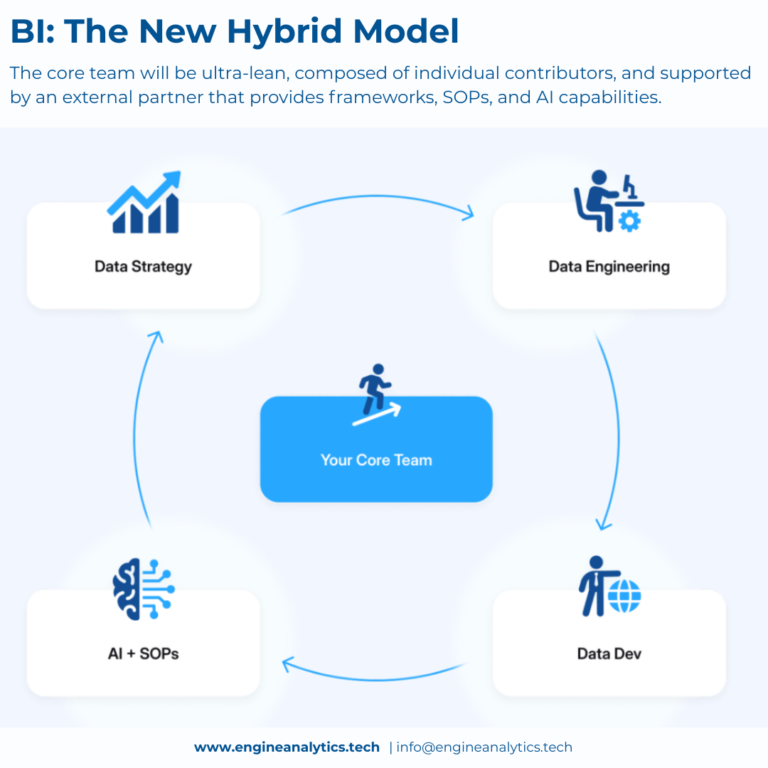
The companies adapting fastest in 2026 are converging on the same operating model:
A. Lean internal BI core (1–3 people)
Covering:
strategy
governance
metric definitions
alignment with leadership
communication
NO repetitive reporting.
NO dashboard babysitting.
NO manual QBR decks.
B. External automation/DataOps partner
For:
pipelines
reporting automation
API integrations
data platform development
validation + monitoring
advanced workflows
The partner becomes the “muscle” the BI team can flex at will.
C. AI layered on top
Not as a fantasy.
As a real, operational component:
anomaly detection
auto-generated summaries
automated data validations
deck generation
intelligent alerting
narrative alignment across regions
The combination is dramatically more efficient.
4. Why This Hybrid Model Wins
Let’s compare.
Old BI Model:
5–7 FTEs
slow decisions
constant rework
overwhelming ad-hoc load
territorial functions
high cognitive overhead
brittle processes
New Hybrid Model:
1–3 internal operators
a technical partner
automated pipelines
AI summarization and QA
clear ownership
lower cost
faster iterations
fewer dependencies
The cost is lower.
The output is higher.
The mental bandwidth is cleaner.
This is operational leverage.
5. The Economics Make the Decision for Companies
This shift is not ideological.
It’s mathematical.
The old model burns:
salaries
time
context-switching
tech debt
repeated manual work
The new model burns none of that.
Companies don’t want “more BI.”
They want:
fewer hours
fewer errors
fewer manual steps
fewer handovers
fewer dashboards
fewer dependencies
And more:
automation
standardization
reliability
transparency
speed
The winning formula = Lean BI + external partner + AI delivers all of this.
6. Why I’m Writing This Now
Because I’ve lived both sides:
inside a slow, political corporate BI machine
and inside fast-moving global teams needing automation yesterday
The truth is simple:
Large BI teams don’t work anymore.
Lean BI teams with leverage do.
This is the model I built ENGINE around – because it’s the only one that makes sense in the real world.
Here’s Some Interesting FAQs for You
Why are BI teams Shirinking in 2026?
BI teams are shrinking because data workloads are shifting from manual reporting to automated pipelines. Companies face cost pressure, headcount freezes, and the rise of AI-driven analysis. Most BI roles historically focused on repetitive reporting tasks – these are now automated or replaced by DataOps workflows.
Is BI being replaced by AI?
Not entirely. AI is replacing repetitive BI tasks (ad-hoc queries, dashboard updates, weekly reporting), but BI leadership and strategic analytics remain essential. The future BI team is smaller, more technical, and focused on system-level thinking, not manual output.
What Skills will BI Analysts need to stay relevant?
In 2026 and beyond, BI analysts need:
SQL + Python
Data modeling
Understanding of CI/CD pipelines
Cloud data stack knowledge (AWS, GCP, Snowflake)
Automation tools
AI-assisted analytics
Business context and stakeholder communication
The winning analysts are becoming hybrid DataOps analysts.