
Artificial intelligence is no longer an experimental technology reserved for global enterprises with massive budgets. Businesses across industries are now investing in automation, predictive analytics, machine learning, and intelligent workflows to improve performance and decision-making. However, many organizations rush into AI projects without understanding whether their existing systems, processes, and data environments are actually prepared for successful implementation.
Evaluating AI Readiness before investing in advanced tools helps organizations identify infrastructure gaps, operational weaknesses, and data quality issues that may prevent AI initiatives from delivering measurable results. A strong foundation allows businesses to deploy scalable systems, maintain compliance, and generate reliable insights from their data assets.
At Engine Analytics, organizations receive strategic support for building modern analytics ecosystems that align with long-term business goals. Whether your company is starting its digital transformation journey or optimizing mature systems, understanding your current readiness level is the first step toward sustainable growth.
This guide provides a practical framework for assessing infrastructure capabilities, governance policies, integration standards, and operational preparedness through a detailed AI readiness checklist.
Many companies focus heavily on selecting AI software while ignoring the underlying systems required to support it. Successful AI initiatives depend on clean data pipelines, scalable storage environments, reliable processing power, and secure governance practices.
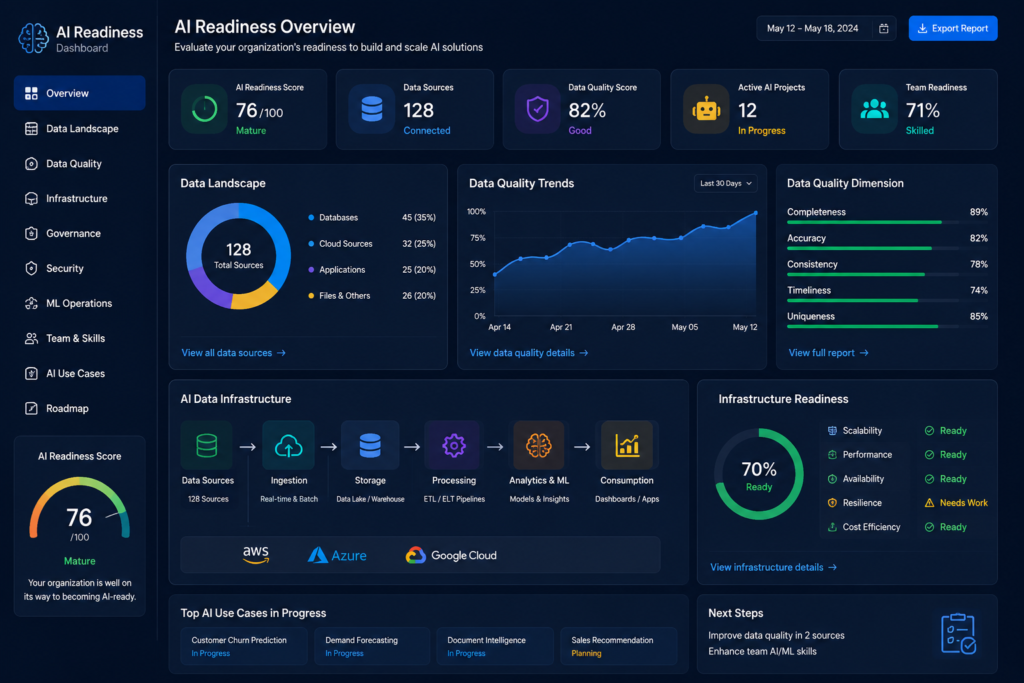
Without a strong AI data infrastructure, even advanced machine learning models will produce inaccurate outputs, inconsistent predictions, and operational inefficiencies. Organizations must therefore evaluate infrastructure maturity before investing in enterprise-scale AI systems.
Strong infrastructure provides several advantages:
A complete approach to organizational AI readiness focuses equally on technology, governance, processes, and people.
The first stage of any AI readiness checklist involves understanding the quality, availability, and accessibility of organizational data.
Businesses often collect information from disconnected systems such as CRM platforms, ERPs, spreadsheets, cloud applications, and operational databases. These fragmented environments create silos that reduce visibility and slow AI adoption efforts.
Your organization should identify:
Organizations that centralize data management are significantly more prepared for intelligent automation initiatives.
AI systems rely heavily on consistent, accurate, and structured information. Poor-quality data creates unreliable predictions and weak analytical outcomes.
Review the following areas carefully:
The IBM AI Governance Resource Center offers useful guidance on improving enterprise data governance and accountability standards.
After auditing your data environment, the next step is evaluating the technical infrastructure that supports analytics and AI workloads.
Modern AI systems require scalable storage environments capable of handling large structured and unstructured datasets. Traditional legacy servers may struggle with increasing processing demands.
Evaluate whether your infrastructure supports:
Organizations planning long-term AI expansion should prioritize flexibility and scalability from the beginning.
Disconnected applications often prevent organizations from achieving seamless AI deployment. Strong integration capabilities improve operational efficiency and data accessibility.
Your AI implementation readiness depends heavily on whether systems can communicate efficiently across departments and platforms.
Questions to evaluate include:
Companies seeking infrastructure modernization support can explore the services offered by Engine Analytics for tailored implementation strategies.
No organization can achieve sustainable AI growth without robust governance frameworks.
Businesses can also explore the IBM AI Governance Resource Center for additional insights into enterprise governance frameworks and responsible AI practices.
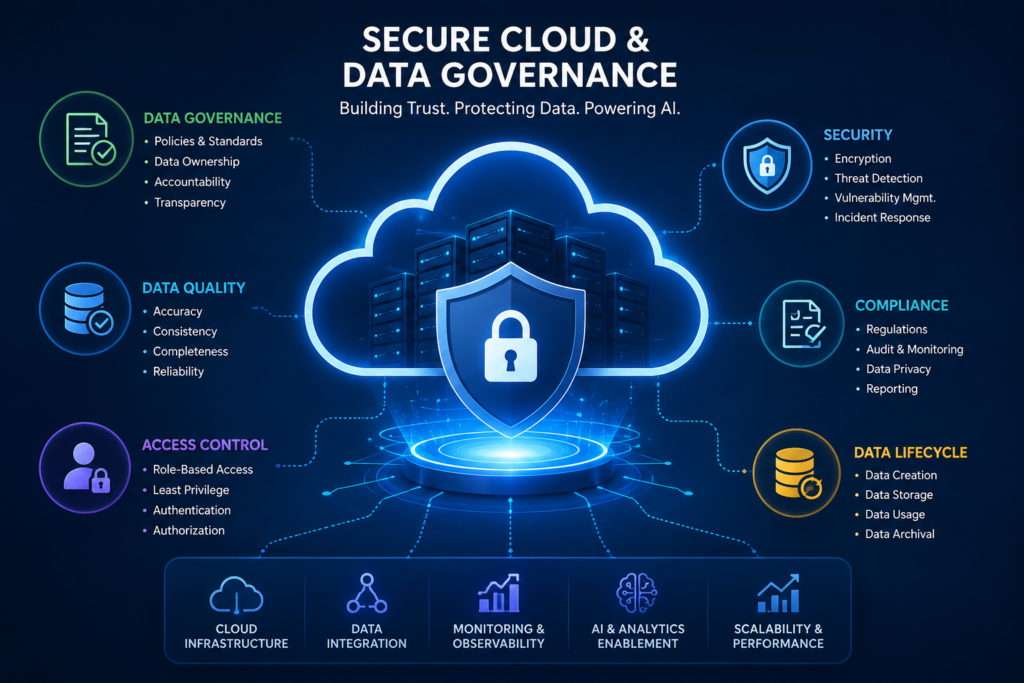
Data governance for AI involves defining policies, ownership responsibilities, compliance procedures, and security standards for organizational information assets.
Strong governance policies help organizations:
Governance frameworks should clearly define who can access data, how information is stored, and which validation processes are required before AI deployment.
AI systems process large volumes of sensitive operational and customer data. Weak security practices can expose organizations to major financial and reputational risks.
Evaluate whether your organization has:
The National Institute of Standards and Technology provides recognized frameworks for managing AI-related risks and security practices.
Technology alone cannot determine enterprise AI readiness. Successful implementation also depends on leadership support, workforce capabilities, and cross-functional collaboration.
Executives should understand how AI aligns with business goals rather than viewing it as a standalone technology investment.
Leadership teams must define:
Organizations with strong executive alignment generally achieve faster adoption and more measurable outcomes.
AI transformation often requires employees to adapt to new workflows, analytical tools, and decision-making processes.
Assess whether teams possess capabilities in:
Upskilling initiatives improve long-term adoption success and reduce implementation resistance.
Operational processes significantly influence the success of AI deployment initiatives.
Inconsistent workflows create unreliable outputs and fragmented reporting structures. AI systems function more effectively when operational processes are standardized.
Review whether departments follow:
Organizations with mature operational structures are better positioned for scalable AI integration.
Resistance to operational change is one of the most common barriers to AI adoption.
An effective AI adoption strategy should include:
Employees are more likely to embrace AI initiatives when they understand the benefits and operational impact clearly.
Advanced AI initiatives depend heavily on strong analytical foundations.
Before implementing predictive models or intelligent automation, organizations should evaluate existing reporting systems.
Questions to consider include:
Weak analytics maturity often indicates deeper infrastructure and governance challenges.
Organizations interested in advanced forecasting or machine learning should evaluate whether they possess:
Strong analytical maturity improves the likelihood of successful AI deployment.
Evaluating infrastructure readiness is only the beginning. Organizations also need a clear strategy for phased implementation and long-term scalability.
Many companies attempt overly ambitious AI deployments during early adoption stages. Starting with focused, measurable initiatives often produces better results.
Common high-value AI applications include:
A phased approach allows organization.
Evaluating AI Readiness is not simply about adopting advanced technology. It is about creating a strong operational foundation that supports intelligent decision-making, scalable infrastructure, secure data management, and long-term innovation. Organizations that prioritize clean data systems, reliable governance frameworks, and scalable analytics environments are far better positioned to achieve successful AI implementation outcomes.
A structured evaluation process helps businesses identify infrastructure gaps, reduce operational risks, improve reporting accuracy, and build confidence before launching AI-driven initiatives. From data governance and workflow standardization to cloud scalability and workforce preparedness, every element contributes to sustainable AI growth.
As competition continues to accelerate across industries, organizations that strengthen their AI infrastructure today will gain a significant advantage in efficiency, automation, and business intelligence tomorrow.
If your business is planning digital transformation or looking to modernize its analytics ecosystem, now is the ideal time to assess your infrastructure capabilities. Explore the advanced analytics and AI solutions offered by Engine Analytics to build a scalable, secure, and future-ready data environment.
Need expert guidance tailored to your business goals? Visit the Services Page or connect directly through the Contact Page to start your AI transformation journey.
AI readiness refers to how prepared a business is to adopt and scale AI technologies through strong data systems, secure infrastructure, skilled teams, and clear operational processes.
A data infrastructure checklist helps organizations identify gaps in storage, integration, governance, security, and data quality before launching AI initiatives, reducing implementation risks and improving results.
Businesses can improve AI readiness by centralizing data sources, upgrading cloud infrastructure, improving data governance policies, training employees, and aligning AI initiatives with business objectives.
