Building an Analytics Center of Excellence (CoE): Best Practices and Pitfalls

Table of Contents

Organizations today are under constant pressure to turn growing volumes of data into meaningful insights. While many companies invest heavily in analytics tools and platforms, far fewer succeed in delivering consistent, enterprise-wide value. This gap often exists because analytics initiatives are fragmented, poorly governed, or disconnected from business priorities. Establishing an Analytics Center of Excellence is one of the most effective ways to overcome these challenges and create a scalable, sustainable analytics capability.

An Analytics Center of Excellence acts as a centralized hub for standards, expertise, and innovation, enabling organizations to align data efforts with strategic objectives. Rather than operating as a siloed technical team, it brings together people, processes, and technology to drive measurable business outcomes. When done right, it accelerates decision-making, improves data quality, and fosters a truly data-driven culture across the enterprise.

However, building a successful CoE is not without challenges. Many organizations struggle with unclear ownership, resistance to change, or unrealistic expectations. This article explores best practices for building an effective Analytics Center of Excellence, common pitfalls to avoid, and practical guidance for long-term success. Whether you are starting from scratch or refining an existing initiative, these insights will help you build a CoE that delivers real business value.

What Is an Analytics Center of Excellence?

An Analytics Center of Excellence is a cross-functional structure that governs, enables, and scales analytics across an organization. It defines how data is managed, analyzed, and used, ensuring consistency while still allowing flexibility for business teams. Unlike traditional analytics teams that focus solely on reporting, a CoE integrates strategy, governance, and advanced analytics capabilities.

At its core, the CoE serves as a bridge between business and technology. It ensures analytics initiatives are aligned with business goals, supported by a robust data governance framework, and executed using best-in-class methodologies. This approach reduces duplication of effort, improves insight quality, and increases trust in data.

A mature Analytics Center of Excellence typically supports multiple use cases, including operational reporting, predictive analytics, and strategic decision support. It also plays a key role in defining the organization’s business intelligence strategy and ensuring analytics investments generate measurable returns.

Why Organizations Need an Analytics Center of Excellence

As organizations grow, analytics often evolves organically within departments. While this decentralized approach offers speed initially, it quickly leads to inconsistencies, conflicting metrics, and governance gaps. An Analytics Center of Excellence addresses these issues by providing structure and shared accountability.

Industry research consistently shows that analytics initiatives fail not because of technology limitations, but due to weak governance and lack of strategic alignment, a challenge widely highlighted in analytics governance research by Gartner.

Key drivers for establishing a CoE include:

  • Increasing demand for reliable, real-time insights

  • Complex data environments requiring enterprise data management

  • The need for consistent metrics and definitions

  • Growing regulatory and compliance requirements

  • Pressure to maximize ROI from analytics investments

By centralizing standards and best practices, a CoE enables organizations to scale analytics without sacrificing quality or control. It also supports collaboration across teams, helping analytics move from descriptive reporting to strategic value creation.

Core Components of a Successful Analytics CoE

Governance and Standards

Strong governance is the foundation of any effective Analytics Center of Excellence. This includes clear policies for data access, quality, security, and lifecycle management. A well-defined data governance framework ensures that data is accurate, trusted, and compliant with regulatory requirements.

Governance should not be overly restrictive. Instead, it should balance control with agility, enabling teams to innovate while maintaining consistency. Clear ownership roles, such as data owners and stewards, are essential for accountability.

Operating Model and Structure

An effective analytics operating model defines how the CoE interacts with business units, IT, and leadership. Common models include centralized, federated, and hybrid approaches. Each has advantages, and the right choice depends on organizational size, culture, and maturity.

A hybrid model is often most effective, combining centralized standards with decentralized execution. This allows business teams to remain agile while benefiting from shared expertise and infrastructure provided by the Analytics Center of Excellence.

 

Analytics Center of Excellence


Technology and Tools

Technology is a critical enabler but should never be the starting point. The CoE should guide tool selection based on business needs, scalability, and integration capabilities. Standardizing core platforms for data integration, visualization, and advanced analytics reduces complexity and cost.

Equally important is ensuring tools are accessible and usable by business users. A strong business intelligence strategy focuses on self-service capabilities while maintaining governance and data integrity.

Best Practices for Building an Analytics Center of Excellence

Align with Business Strategy

The most successful Analytics Center of Excellence initiatives are tightly aligned with business objectives. Start by identifying priority use cases that deliver measurable value, such as revenue growth, cost optimization, or risk reduction. This alignment helps secure executive sponsorship and demonstrates early wins.

Build a Multidisciplinary Team

A CoE requires more than technical skills. Successful teams include data engineers, analysts, data scientists, and business translators who understand both analytics and business context. This diversity ensures insights are relevant, actionable, and trusted by stakeholders.

Start Small and Scale

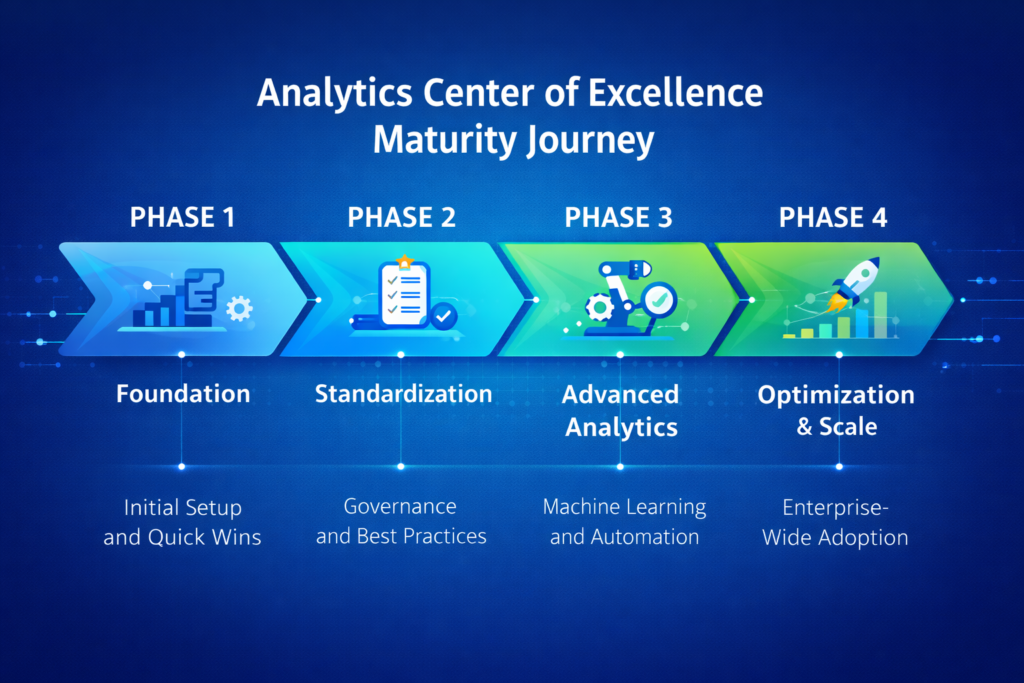
Avoid the temptation to build everything at once. Begin with a focused scope, establish standards, and deliver quick wins. As maturity grows, expand capabilities and responsibilities. This phased approach reduces risk and builds momentum for the Analytics Center of Excellence.

Invest in Enablement and Training

Creating a data-driven culture requires continuous education. The CoE should provide training, documentation, and communities of practice to empower business users. When people understand how to use data effectively, analytics adoption increases significantly.

Common Pitfalls to Avoid

Despite good intentions, many Analytics Center of Excellence initiatives fail to deliver expected value. Understanding common pitfalls can help organizations avoid costly mistakes.

One frequent issue is treating the CoE as a purely technical function. Without strong business engagement, analytics outputs often lack relevance and adoption. Another pitfall is over-centralization, which can slow innovation and frustrate business teams.

Lack of clear success metrics is also problematic. Without defined KPIs, it becomes difficult to demonstrate value or justify continued investment. Finally, underestimating change management can derail even the best-designed Analytics Center of Excellence. Resistance to new processes and tools must be addressed proactively.

Embedding a Data-Driven Culture

Technology and governance alone cannot ensure success. A true data-driven culture is essential for maximizing the impact of an Analytics Center of Excellence. This culture encourages curiosity, transparency, and evidence-based decision-making at all levels.

Leadership plays a critical role by modeling data-driven behavior and reinforcing its importance. Incentives and performance metrics should reward data-informed decisions rather than intuition alone. Over time, this cultural shift transforms analytics from a support function into a strategic asset.

Measuring Success and Maturity

Measuring the effectiveness of an Analytics Center of Excellence requires a balanced set of metrics. These may include adoption rates, data quality improvements, time-to-insight, and business outcomes achieved through analytics initiatives.

Maturity models can help organizations assess progress and identify areas for improvement. As the CoE evolves, its focus often shifts from foundational capabilities to advanced analytics and innovation, supporting long-term competitive advantage.

Leveraging External Expertise and Resources

Many organizations accelerate CoE maturity by partnering with experienced analytics providers. External experts bring proven frameworks, industry best practices, and objective perspectives that reduce trial-and-error.

Authoritative research from organizations like Gartner and McKinsey & Company consistently highlights the importance of governance, talent, and culture in analytics success. Leveraging such insights can help shape a resilient Analytics Center of Excellence.

For organizations seeking hands-on support, exploring professional analytics services can provide practical guidance on strategy, architecture, and execution. You can learn more about tailored analytics offerings on the services page.

Analytics Center of Excellence


Integrating the CoE with Enterprise Data Management

An effective Analytics Center of Excellence does not operate in isolation. It must integrate closely with enterprise data management initiatives to ensure consistency across data sources and platforms. This integration supports scalability, reduces redundancy, and enhances data reliability.

By aligning data architecture, metadata management, and governance processes, organizations create a strong foundation for advanced analytics. This holistic approach ensures analytics insights are built on trusted, well-managed data assets.

Future-Proofing Your Analytics Center of Excellence

Analytics capabilities continue to evolve rapidly, driven by advances in automation, artificial intelligence, and cloud technologies. To remain relevant, an Analytics Center of Excellence must be adaptable and forward-looking.

Regularly reviewing the analytics operating model, updating standards, and experimenting with emerging technologies helps keep the CoE aligned with business needs. Continuous improvement ensures the Analytics Center of Excellence remains a strategic enabler rather than a bottleneck.

Conclusion: Turning Analytics into a Strategic Advantage

Building an effective Analytics Center of Excellence is a strategic investment that pays dividends over time. By aligning analytics with business objectives, establishing strong governance, and nurturing a data-driven culture, organizations can unlock the full potential of their data.

Success requires thoughtful planning, executive support, and a willingness to evolve. When implemented correctly, an Analytics Center of Excellence becomes a catalyst for innovation, efficiency, and competitive advantage.

If you are ready to transform your analytics capabilities and build a scalable foundation for growth, explore how expert guidance can accelerate your journey. Visit the Engine Analytics homepage to learn more, or reach out directly through the contact page to start the conversation today.

Here’s Some Interesting FAQs for You

The primary role of an Analytics Center of Excellence (CoE) is to create a unified, enterprise-wide approach to analytics by standardizing processes, tools, and methodologies. It acts as a central authority that defines best practices for data usage, reporting, and advanced analytics while ensuring alignment with overall business objectives.

Beyond standardization, an Analytics CoE establishes strong governance to maintain data quality, security, and consistency across departments. This helps eliminate conflicting metrics, duplicate efforts, and unreliable insights. Most importantly, the CoE enables analytics to scale sustainably by providing shared expertise, reusable assets, and strategic oversight—ensuring that analytics initiatives consistently deliver measurable business value rather than isolated insights.

The time required to establish an Analytics CoE depends largely on an organization’s size, data maturity, and strategic ambition. In many cases, the initial setup—defining the vision, governance structure, and priority use cases—can take anywhere from three to six months. This phase typically focuses on quick wins that demonstrate the value of centralized analytics.

Achieving full maturity, however, is a longer journey. A fully operational and optimized CoE—one that supports advanced analytics, self-service capabilities, and enterprise-wide adoption—may take one to two years. Progress is faster when organizations start with a focused scope, secure executive sponsorship, and incrementally expand capabilities rather than attempting a large-scale rollout all at once.

Yes, small organizations can gain significant advantages from a right-sized Analytics Center of Excellence. A CoE does not need to be a large or complex structure to be effective. Even a small, lean team or virtual CoE can provide governance, standard definitions, and shared analytics practices that prevent chaos as data usage grows.

For smaller organizations, a CoE helps establish good habits early—such as consistent reporting, reliable data sources, and clear ownership—reducing future rework and inefficiencies. It also enables leadership to make informed, data-backed decisions without requiring heavy investments. As the organization grows, this foundational CoE can scale naturally, supporting more advanced analytics and strategic initiatives over time.